Featured

The New Gallery – Walsall

I’ve been kickstarting off 2020 with a series of gallery visits, The Hepworth and Sculpture Park in Wakefield, Salts Mill in Saltaire and this last weekend The New Gallery in Walsall.
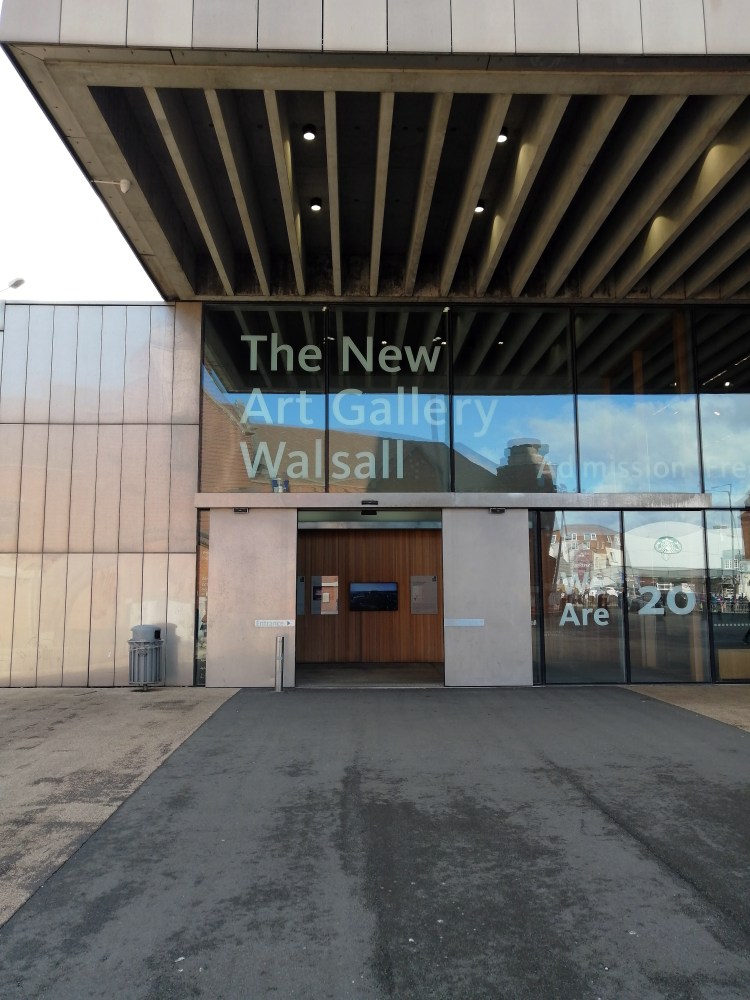
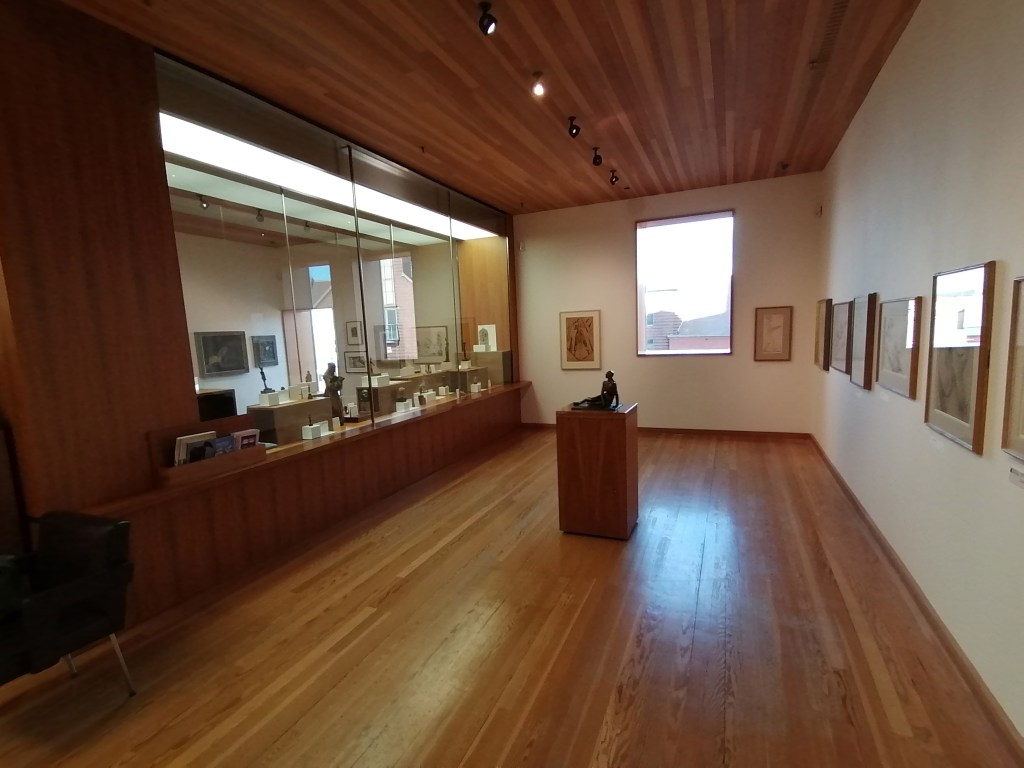
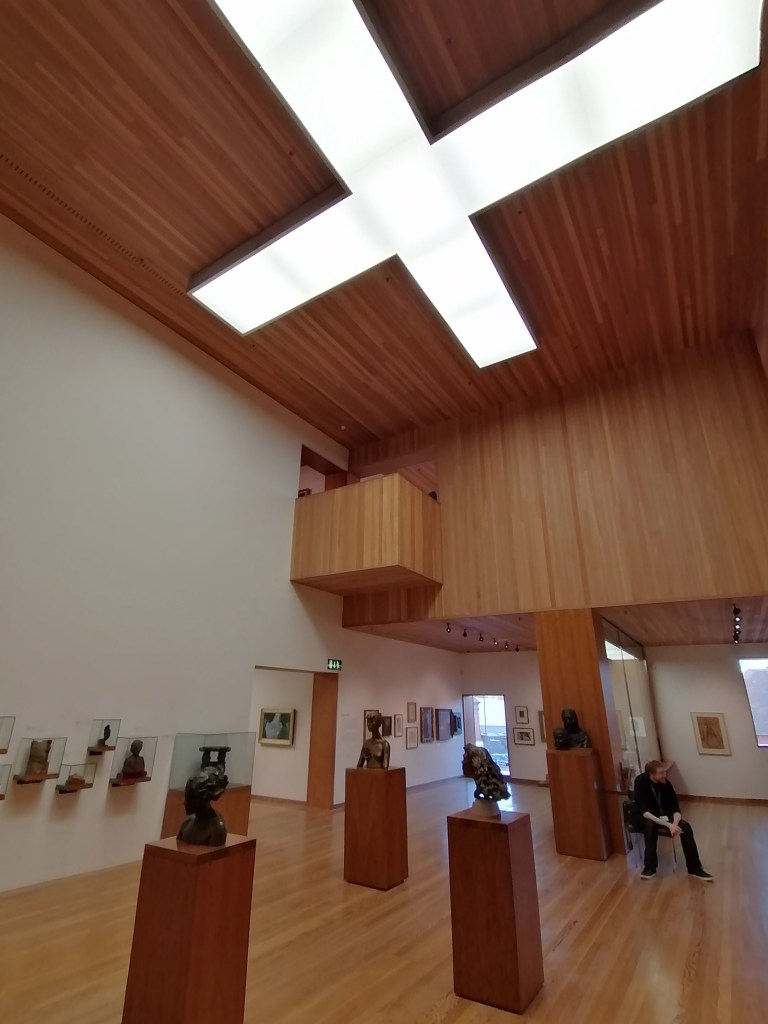
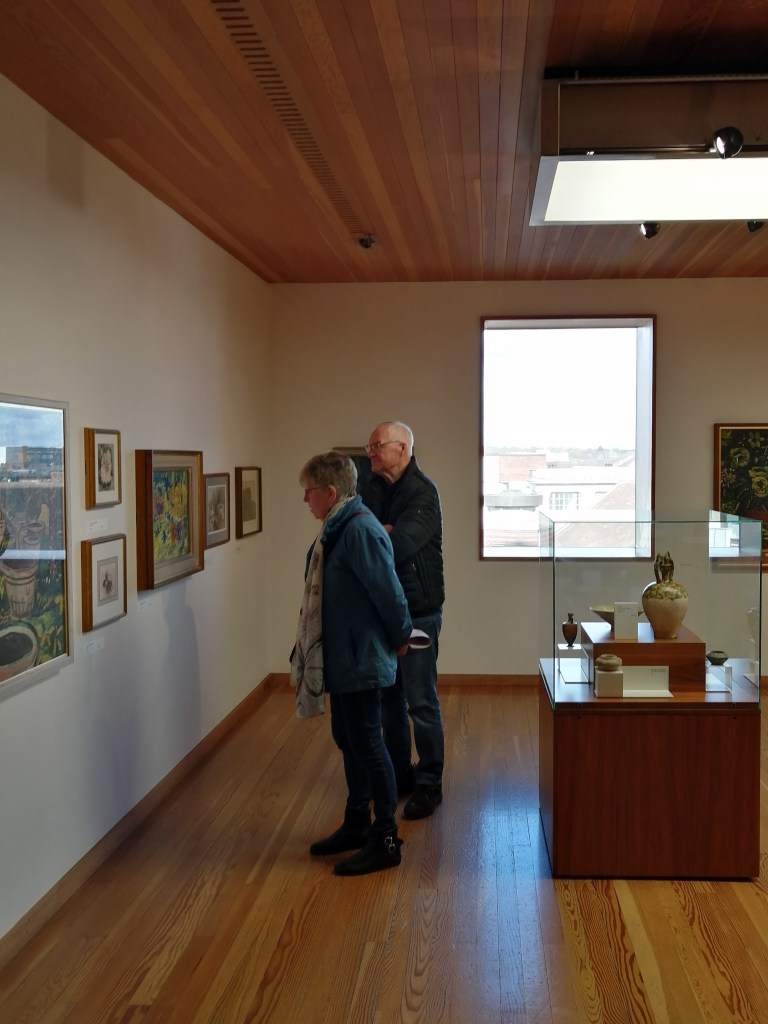
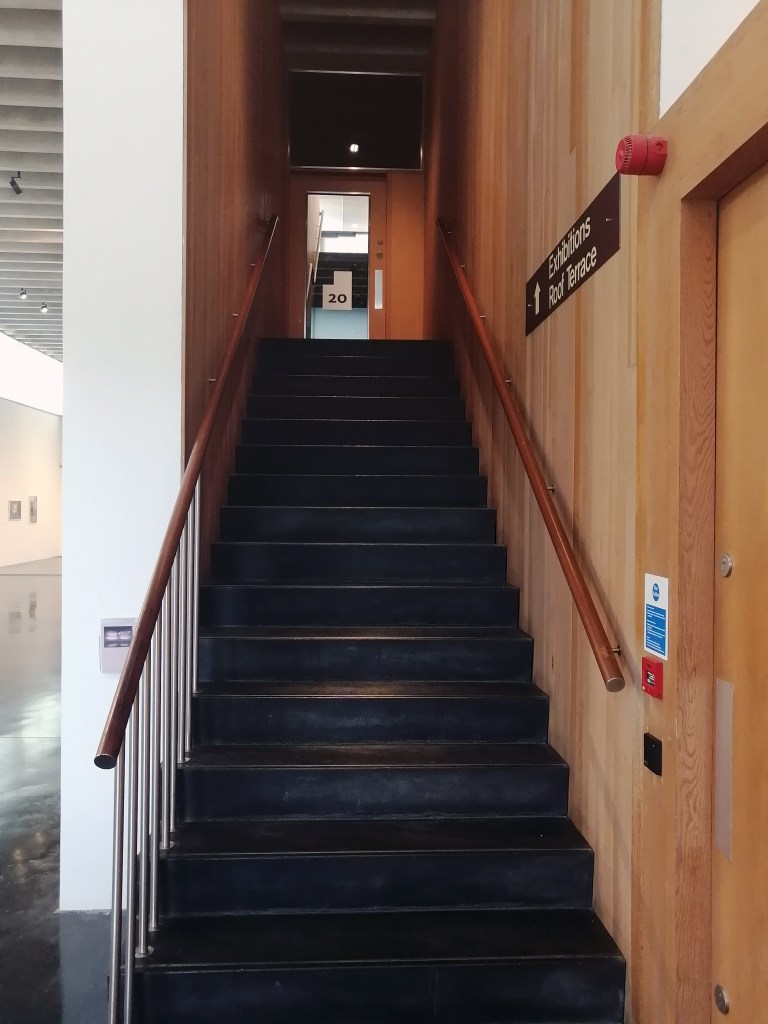
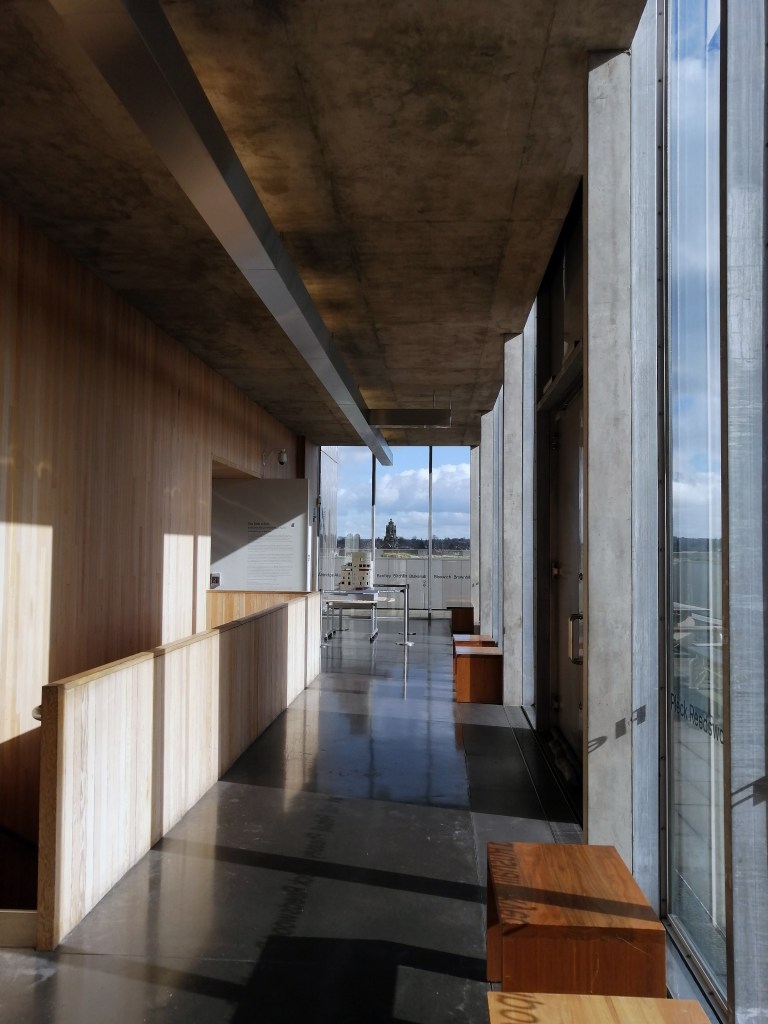
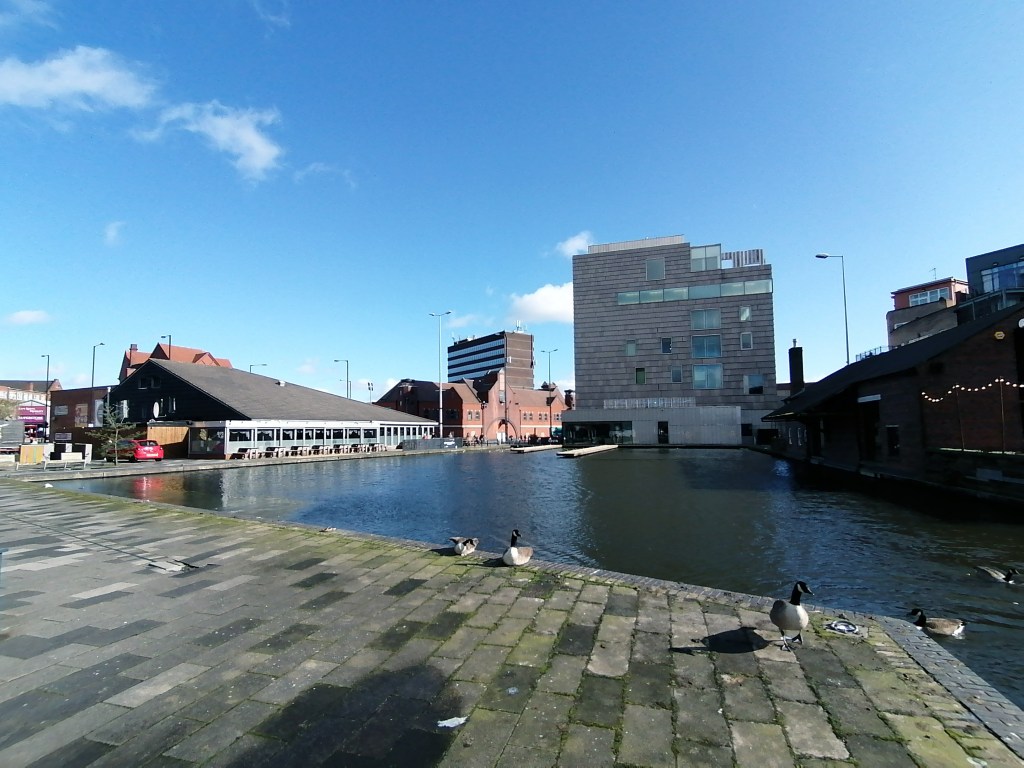
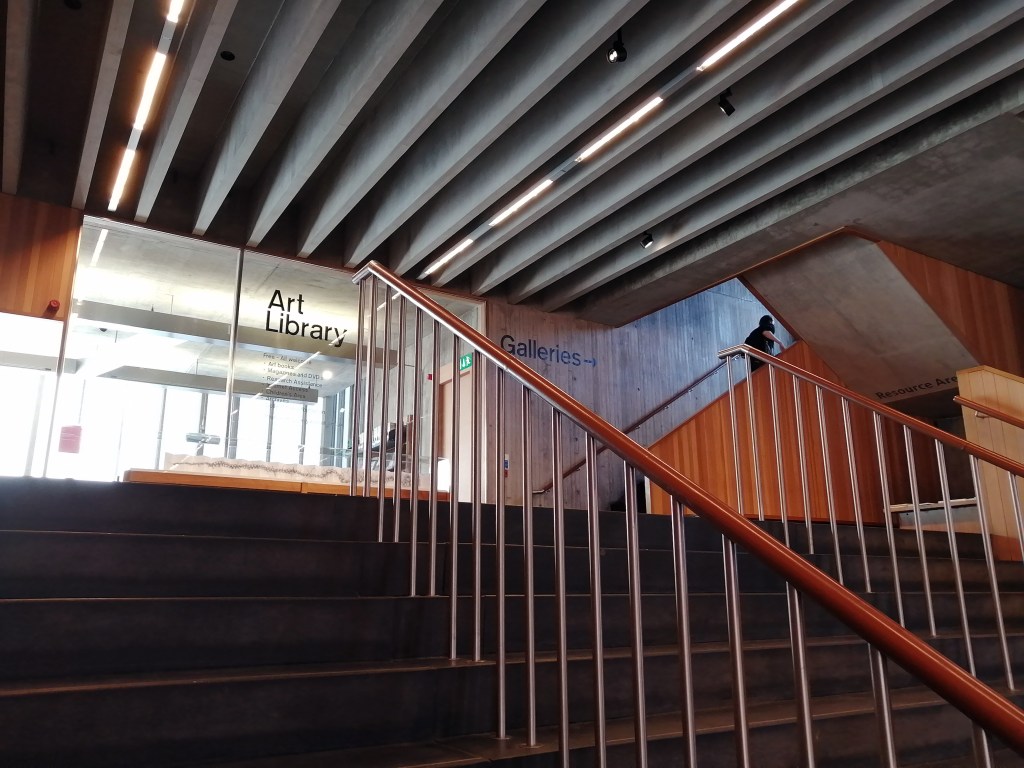
The New Gallery is a stunning contemporary gallery, completed in 2000, they’re celebrating 20 years with 20 pieces of artwork from every year. This is a timeless building that really does not show its age, with beautiful foyer and many gallery spaces. The impression I get is the architect and stakeholders have gained a great balance of the spaces within. There is a community gallery for everyone on the ground floor with windows opening out onto the street. A permanent gallery of Jacob Epstein’s work, on the middle two floors with timber clad walls and flooring to give it a more homely feeling.

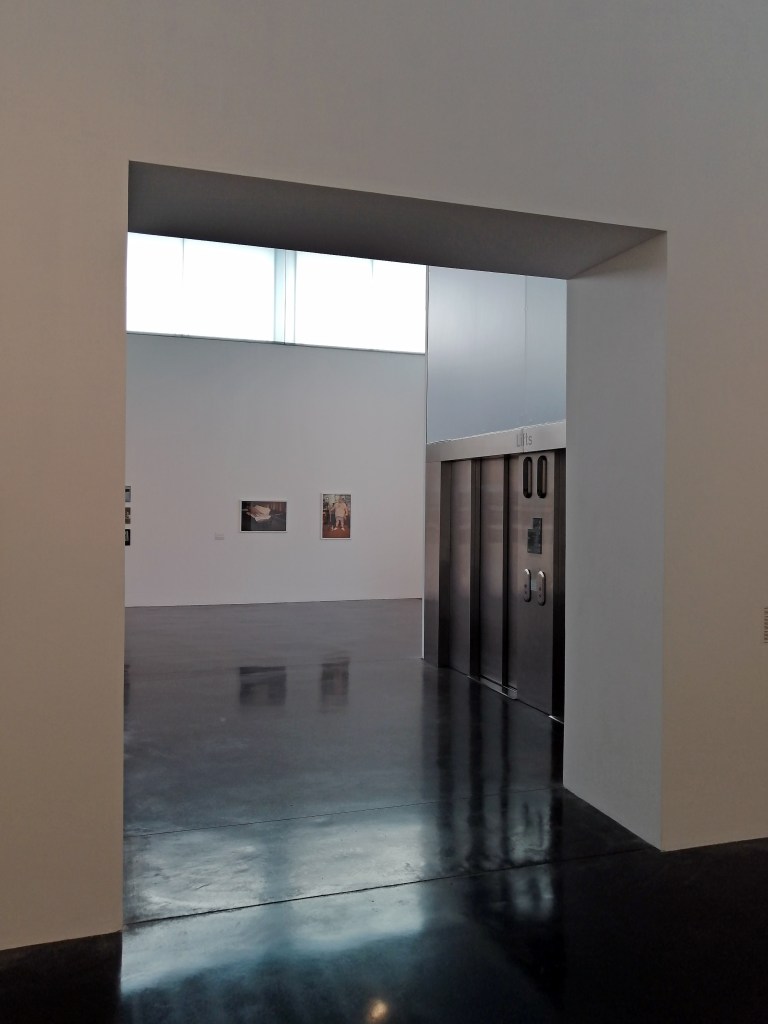
Next floor upwards is a large, multipurpose cliche white gallery. I say cliche as it is the typical blank canvas in which anyone can present any form of art or media. On my visit I discovered a mixed media selling cart with background noises and a full room projection of space and constellations, quite fascinating what contemporary art can be produced.
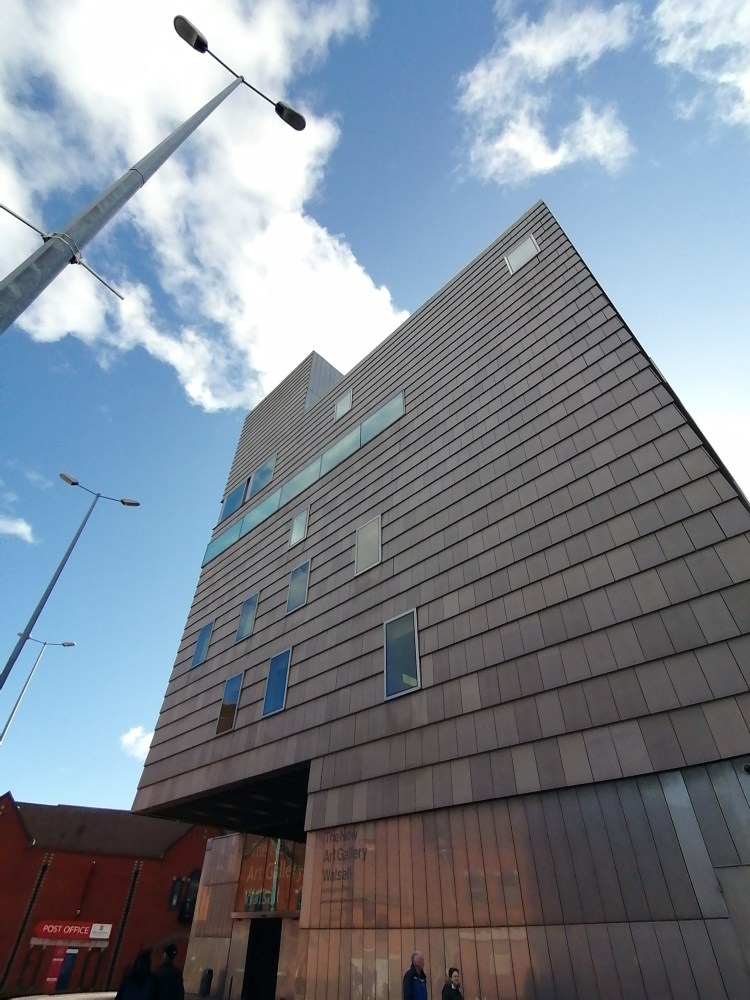
The next floor and at the very top you can find another gallery, which was originally concieved as a restaurant with beautiful large windows overlooking Walsall, but now covered up to create hanging space. The footprint and verticality of the gallery gives it a feeling of The National Gallery but vertical. The typology of the building gives a clever flow of an upwards ascent to be followed by a descent via the lifts.

Overall, I’ve really enjoyed my visit to this gallery and have learnt a lot about how different spaces are composed and the importance of a variety of gallery spaces within one building. I’ve enjoyed the usage of light within the building but am not entirely sold on the external composition of windows. I feel that the internal connection with natural light has taken precedence over the aesthetical design of the external envelope, although this is entirely personal opinion. I would definietly return to experience other artists using the spaces in different ways.
Thermal Bridging: Where the detail leak through design

Thermal bridging is one of those quiet realities of building science, invisible until it isn’t. It’s the weak point in a wall, floor, or roof, where heat finds the path of least resistance and slips away. Sometimes it’s accidental, a screw in the wrong place. More often, it’s a consequence of poor detailing or a junction that wasn’t quite thought through.

In practice, I’ve found it appears most often where materials or geometries converge: the floor-to-wall junction, the eaves, or around window frames. These are the areas that look neat on a drawing but reveal their flaws when condensation, or worse, mould begins to form.

In the UK, we’ve become almost obsessive about these small thermal leaks. Our regulations demand that we not only acknowledge them but measure them. Every new dwelling requires a SAP energy model, which explicitly accounts for thermal bridges through psi-values (ψ-values), those fractional losses that define the efficiency of a home.

For commercial buildings, we use SBEM (Simplified Building Energy Model) and yes, it is mandatory for compliance with Part L of the Building Regulations. Across the Atlantic, the US is a different phase of the same conversation. Codes like ASHRAE 90.1 and the IECC exist, but most projects still demonstrate compliance through an R-value method; a simple averaging of insulation layers to reach a total thermal resistance.

That’s slowly changing. Some projects in Massachusetts is adopting “stretch” and “specialized” energy codes, which replace this broad-brush R-value method with the U-factor approach already familiar in the UK and Europe. The newer standards consider the real-life interruptions in the building’s thermal blanket and ensure proper detailing.

The difference between the two countries isn’t just how they calculate performance, its in how they build for it.

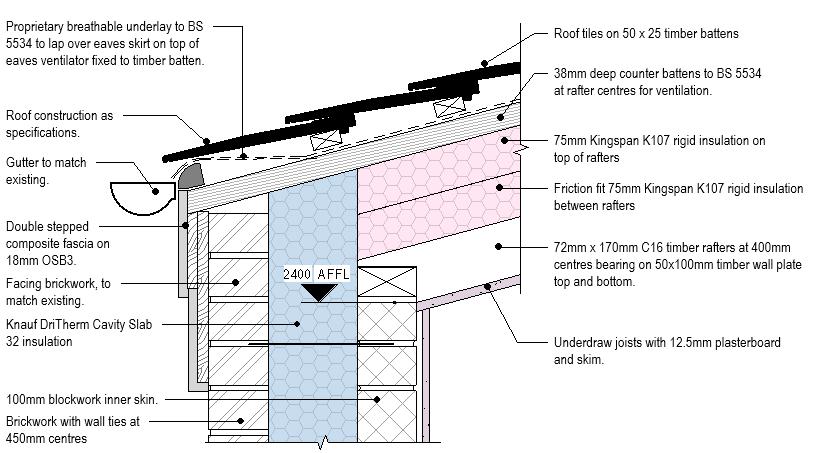
In the UK, our cavity wall system has long been the unsung hero of energy efficiency. Two solid leaves of masonry with a continuous layer of insulation between. A pragmatic and durable solution. But as regulations tighten, the cavity is widening; from 100mm (4”) to 150mm (6”) in many cases. The walls grow thicker, the sites grow smaller, and the details become more complicated. Even the humble thermal cavity closer is now required in new, wider formats.

Diagram illustrating roof construction details, including insulation layers, timber rafters, and ventilation components, emphasizing thermal bridging aspects.
UK brick and block eaves detail with full fill cavity insulation

In the US, construction has historically favoured the timber stud wall, fully filled with insulation. It’s quick and economical, but thermal continuity stops at every stud. The push for continuous insulation is gaining traction but brings its own set of challenges. Different windows, specialist fixings, high costs, and reluctant contractors make it a slow revolution.

Detailed architectural drawing showing the construction elements of a roof and eave, including standing seam panels, plywood, metal trim, gutters, fascia board, and cedar shingles.
US 2×6 stud eaves detail with continuous insulation

Thermal bridging is rarely felt directly. Most occupants won’t notice the bridge itself, they’ll notice what follows is a chilly patch on the wall, higher heating bills, or worse-case mould. It’s a practical comfort problem, not just theoretical.

In the UK, with higher energy costs and a national focus on decarbonisation, thermal performance has become part of architectural identity. We speak of U-values and airtightness as easily as form and proportion. In the US, where energy is cheaper and climates wildly varied, the urgency differs. Some regions battle to keep heat in, others to keep it out. “Cold bridging” doesn’t quite fit when the challenge might be just as easily be solar gain.

A construction site with unfinished walls made of bricks and blocks. A pile of mortar is on a wooden platform, and building materials are visible in the background.

For all its science, the phrase thermal bridging has always felt poetic to me. It’s about connection and consequence. A bridge can unite or it can leak. It can carry the flow of heat, or the flow of ideas between two ways of building.

In my work, I see the literal and figurative bridges everywhere: between cost and performance, between detail and construction, between architect and builder. Sometimes the connections are strong and efficient; sometimes they bleed energy and understanding alike.

To design better buildings we need fewer gaps, both thermal and professional.

Bathrooms Across the Pond: Notes from an Architect Working in Two Codes

I never expect that the first cultural difference of working between the two countries would focus on bathrooms but this is the Damp Patch.

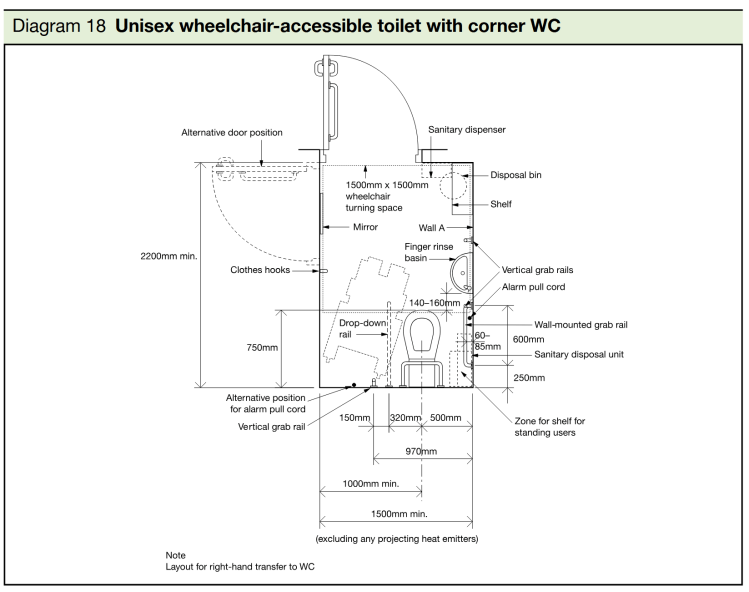
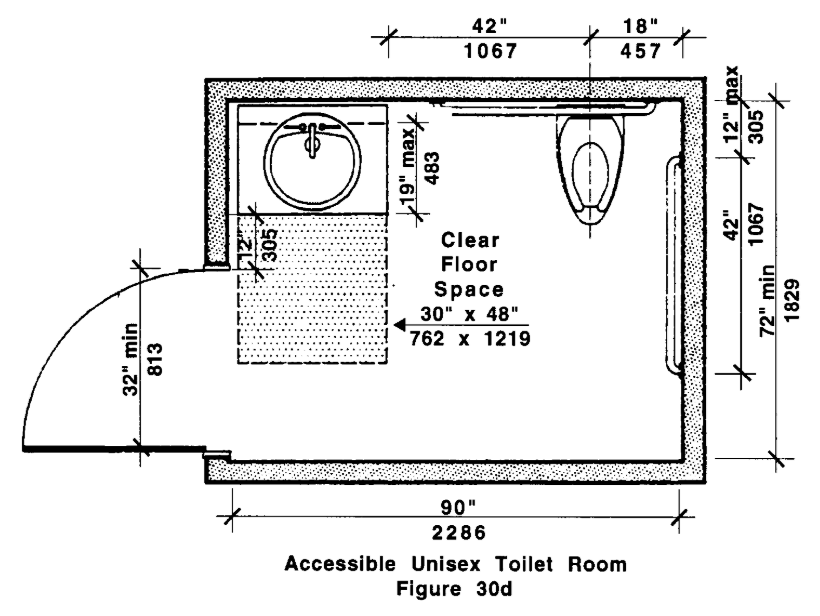
Coming from the UK, where a compliant fully accessible WC is a snug 2.2m x 1.5m (7′-3” x 4′-11”) box of pure function, comparing to my first Massachusetts project felt like an indulgence: a 90in x 72in (2286mm x 1829mm) room that could almost pass for a small bedroom. You can basically swing a cat in it! But the real differences lie not in size, but in philosophy.

In the UK, everything is tightly choreographed. The basin sits within arm’s reach of the WC, perfectly placed for someone transferring or washing hands before repositioning their chair. Its a detail born of necessity, the space is small and every millimeter counts.

UK accessible bathroom

The drop down rail to the open side is another quiet triumph of practical design. It gives a user genuine independence and flexibility. I took it for granted until I began working in the US and realised that, under 521 CMR, it simply doesn’t exist. Instead, the grab bars are rigidly fixed: one to the side, one behind. I’ve yet to understand how the rear one truly helps anyone other than to bruise their knuckles!

US Accessible WC layout

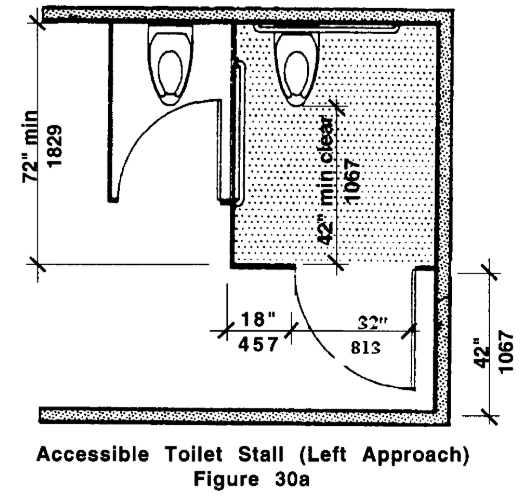
Another key distinction is how the two systems define accessibility itself. In the UK, a building must provide a dedicated, self-contained accessible WC, a recognisable, stand-alone room with its own proportions and fittings. In the US, compliance can often be achieved within a main restroom if at least one stall meets the required dimensions and clearances. Both achieve accessibility, but in very different ways.

US Accessible stall layout

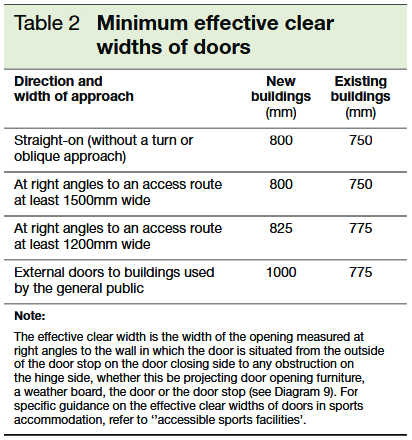
Door clearances tell another story. Both countries require almost the same. 800mm (31.5in) in the UK and 32in (813mm) in Massachusetts, yet the spatial choreography is entirely different. In the UK we only allow outward swinging doors to preserve manoeuvring space inside. In the US, may doors open inwards, prioritising the corridor over the room. It’s a subtle difference, but one that completely changes how a wheelchair user approaches the room.

Nothing captures the divide better than the electrics.

In the UK, a bathroom is practically sacred ground: sockets are banned except for shaver outlets, and even then only beyond Zone 2 per BS 7671:2018. These zones are measured distances from baths, basins, and showers, designed to keep electricity far from splashes.

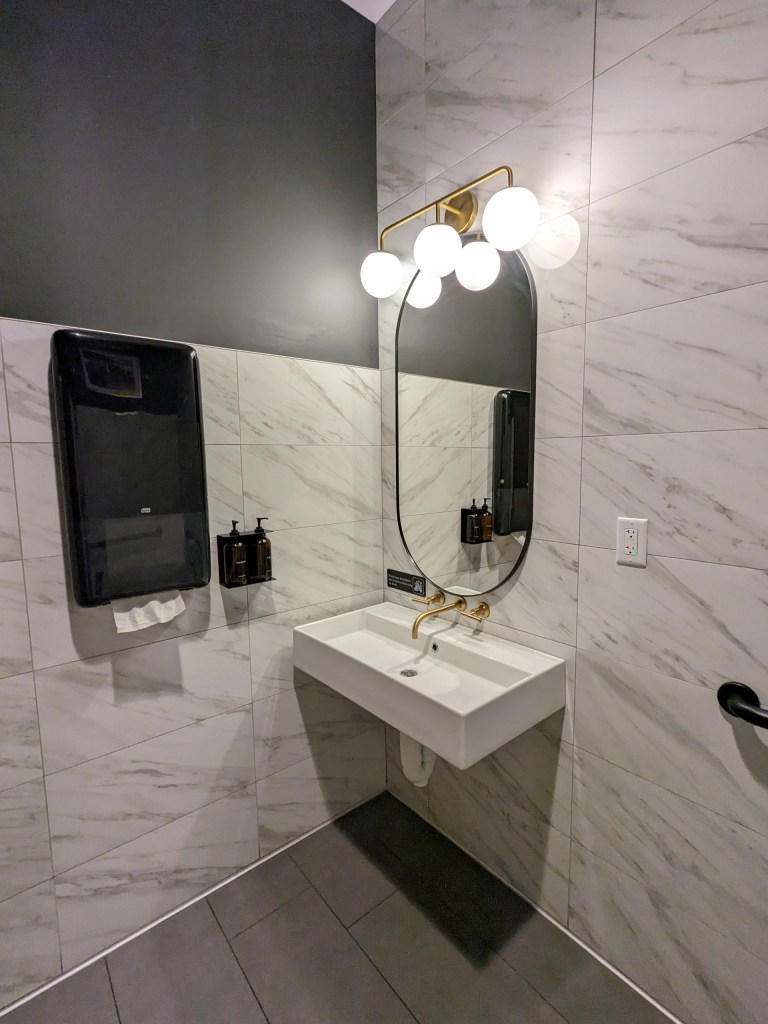
In the US, bathrooms are dotted with GFCI-protected outlets (see those reset buttons?). They’re near sinks, mirrors, and even beside toilets. It’s a fascinating contrast in risk philosophy: British caution versus American convenience.

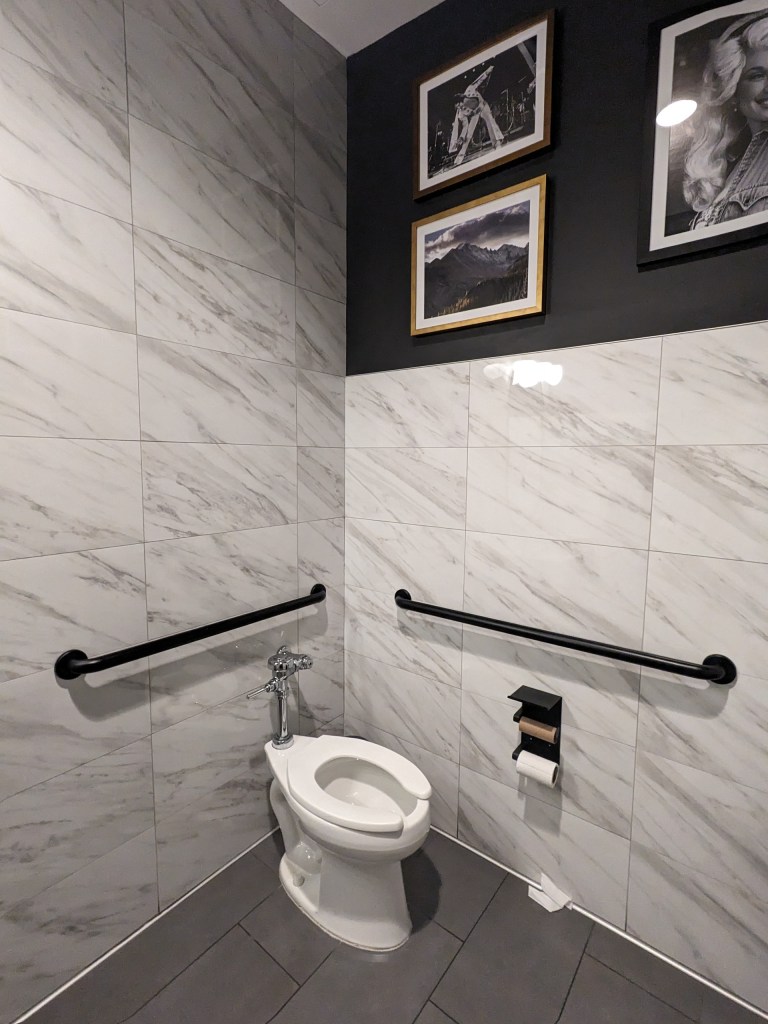
Visual contrast is another area where British precision meets American looseness in my experience. In the UK, we follow Light Reflectance Value (LRV) guidance, ensuring atleast 30-point difference between grab rails and their backgrounds. Consider black being 0 LRV and pure white is 100 reflecting all light. It’s a subtle way of making fittings visible to people with low vision.

UK Accessible WC, note the grab bars!

In the US, contrast is often left to aesthetic preference. Accessibility is measured in inches and pounds, not colo(u)rs and tones. It’s an omission that says as much about regulatory culture as it does about design priorities.

Interesting the roles reverse when it comes to water efficiency. Massachusetts is impressively strict: WCs are limited to 1.28 gallons per flush (4.8L). The UK’s Part G takes a broader approach, suggesting limits but often leaving specifics to voluntary schemes.

So while the British bathroom is spatially efficient, the American one is environmentally so.

Another US bathroom, just look at the size and style!!

If I had to sum up the difference, I’d say the US bathroom is experience-driven; the UK bathroom is compliance-driven.

The American approach is about comfort and perception, generous space, abundant lighting and a sense of calm. The British approach is about precision, meeting the diagram, hitting the numbers and proving inclusivity through layout rather than luxury.

Neither is wrong. Both are responses to context, climate, and culture. Yet I can’t help feeling that the perfect accessible bathroom lies somewhere between them.

Introduction

Article 1 : The Transatlantic Divide: Building Science Across the Pond

Technical Eaves Detail

Building science, or building physics, has always fascinated me, the way buildings respond to their environments, the materials we use, and the decisions that shape how we live within them.

Over the years, my work as a practising architect in the UK and as a contractor in the New England states of the US has given me a unique vantage point. Moving between two building cultures, I’ve come to appreciate just how differently we think about constructing the same thing: simple, comfortable, and efficient buildings.

At a first glance, the principles seem universal, insulation, airtightness, ventilation, comfort. But the moment you look closer, the variations are striking. The regulations along, from the UK’s Building Regulations to Massachusetts’ State Building Code, reveal two distinct philosophies. What’s considered standard practice in one country can be a curiosity in the other. Even the most ordinary details, a bathroom layout or wall build-up, can expose decades of divergent climate responses, construction traditions, and cultural expectations.

In the UK, we tend to build with masonry and layers of insulation, prioritising compactness and energy efficiency. Across the Atlantic, timber framing dominates, and comfort often means more space and more mechanical control. Neither is inherently ‘better’, they simply tell different stories about how we’ve adapted to our environments and economies.

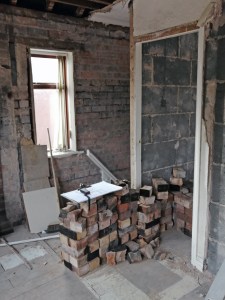
UK Renovation project using bricks and blocks

This series is my attempt to explore those stories. It’s not a textbook or code manual, but a place to share observations, research, and reflections on how we design, build, and occupy our spaces. Some articles will be technical; others more anecdotal. The aim is to bridge the gap between theory and practice, and between the two construction cultures that have more in common than they realise.

Whether you’re an architect, a student, or someone simply curious about why buildings are the way they are, I hope these notes offer both insight and inspiration. I’ll touch on everything from thermal performance to material choices, from the quirks of US bathroom sizing to the science of airtightness (if I can unravel that!) and perhaps along the way, we can start to see how the two worlds might learn from each other.

Reflections and Anticipation for the Future.

As we close out another year and welcome in a new one, I wanted to take a moment to reflect on the past and look ahead to the future. It has been an interesting and challenging year, and I am grateful for the opportunity to continue learning and growing as an architect.

As I look ahead to the new year, I am filled with excitement and anticipation for what is to come. I don’t know exactly where my path will take me, but I am ready to embrace new opportunities and challenges as they arise. With new project, continuing studies, and working on personal projects, I am eager to see where my passions and interests will lead me.

I want to thank all of my readers for following along on my journey. Your support and encouragement have meant a lot to me, and I am grateful to have such a wonderful community to share my experiences with.

Here’s to a new year full of possibilities and growth. I am looking forward to seeing where things go, and I hope you are too.

Have a wonderful year to you and yours,

Ed

Finished for Christmas

Dear Readers,

I am thrilled to announce that I have successfully completed my dissertation, encompassing the role of the digital world within architecture. It has been a long and challenging journey, but I am so proud of the results and grateful for the support of my tutors, colleagues, friends and family.

Through my research and writing, I explored the increasingly important role of digital technology in the field of architecture. From design and visualization tools to construction and project management, the digital world has transformed the way we approach and create buildings and spaces.

As I look back on the past year, I am grateful for the opportunity to study and learn about the fascinating world of architecture. It has been a privilege to delve into the history, theory, and practice of this field, and I am excited to continue exploring and growing as an architect in the future.

As the holiday season approaches, I want to take a moment to wish all of my fellow students, colleagues, and readers a very merry Christmas. I hope that you are able to spend time with loved ones, relax, and recharge during this special time of year.

Thank you for following along on my journey as a student architect. I am excited to see what the future holds and look forward to sharing more updates with you in the new year.

Sincerely,

Edward

Dissertation Submitted!

Hello readers,

I am excited to announce that I have submitted my dissertation in architecture. This has been a long and challenging journey, and I am grateful to have reached this milestone. I want to take a moment to thank my tutors, professors, and peers for their support and guidance throughout this process. I could not have done it without them.

As I await feedback from my course, I am looking forward to seeing what they have to say about my work. I have put a lot of time, effort, and thought into this project, and I am eager to see how it is received. Whether the feedback is positive or constructive, I know it will help me to grow and improve as an architect.

In the meantime, I am progressing with other course submissions. Thank you for following my journey and I am excited to see what the future holds and look forward to sharing more updates soon.

All the best,

Ed

Design Exploration

This week I’ve been busy working on my design project. I’m looking at the brief of the main building; what are the spacial requirements and how this relates to the context.

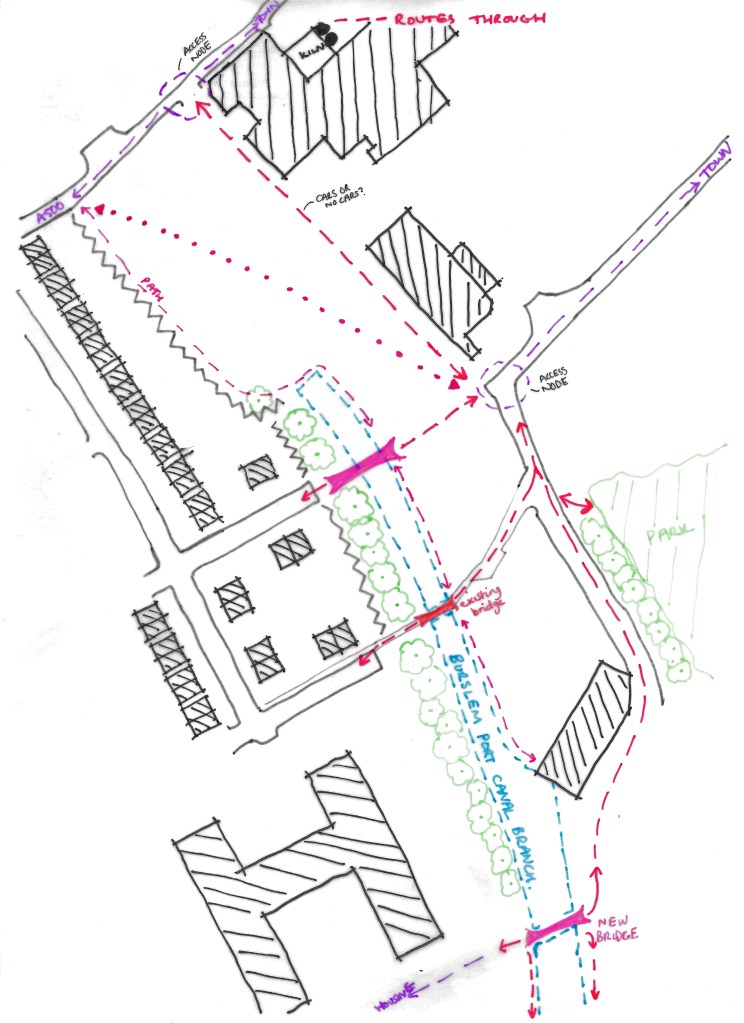
Looking at the wider masterplan of the site I’m exploring access to and through the site, exploring the history of the site and how this may inform the proposals.

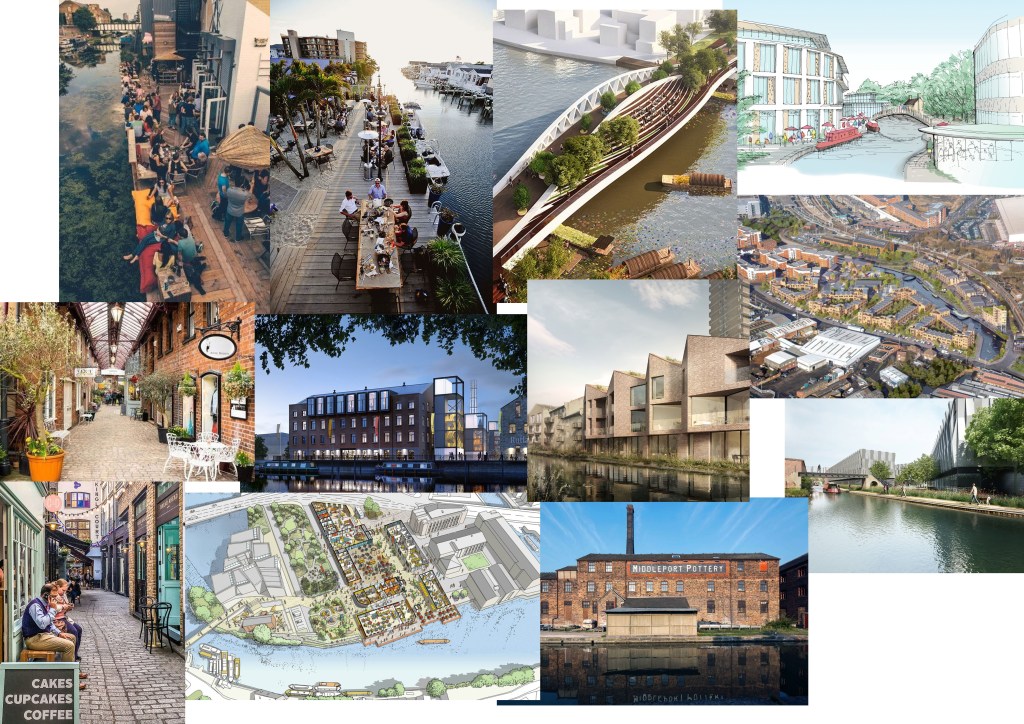
Next looking into precedent to guide the design I’ve found some interesting projects including; Hawkins/Brown Wakefield project next to the Hepworth to develop a 20yr disused mill on the canal front and a Chapman Taylor project in Wolverhampton.

Sensing Spaces

Stripping the Royal Academy of its traditional artwork, the 2014 sensing spaces exhibition explored the architecture of the everyday and investigates the way we think and feel. With architects from across the world such as Alvaro Siza and Eduardo Souto de Moura, the exhibition was designed to explore the fundamental elements of architectural space.

Pezo von Ellrichshausen – photograph by James Harris

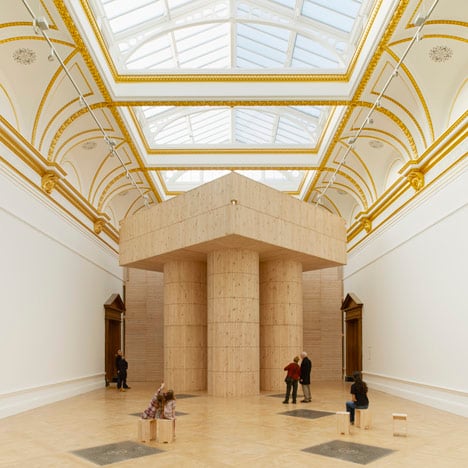
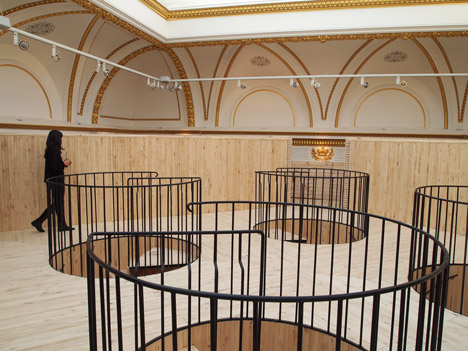
My favourite room specific architectural exhibit is a wooden structure by Pezo von Ellrichshausen of a simplistic monolithic timber structure. It must make the viewer inquisitive of the purpose of the forms. Explore a little further, the timber columns reveal spiral staircases up to an elevated deck with head-height wrap around panelling, guiding the viewers eyes upwards to the elegant and ornamental gilded ceiling of the space. This interesting exhibit focusses in on and glorifies the architecture of the space that is usually overlooked. Expressing the size and scale of gallery space it is a unique space-changing installation. It gives a three-dimensional dynamic to the otherwise linear gallery.

Pezo von Ellrichshausen – image by Dezeen
Grafton Architects – photograph by James Harris

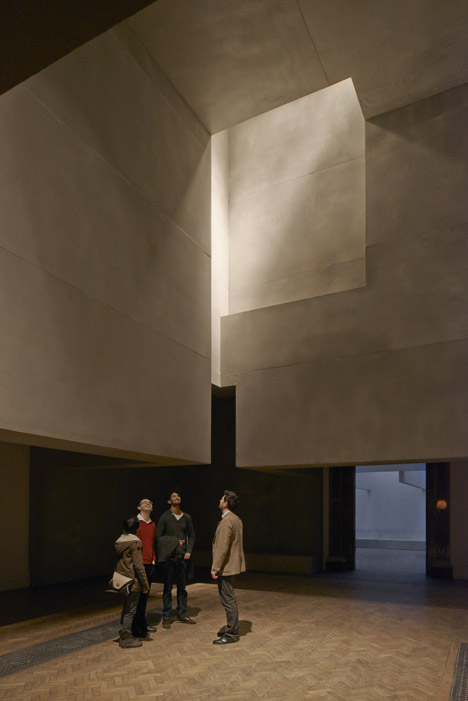
The second exhibit to pique my interest is by Grafton Architects, who suspended large wooden structures from the ceiling. The aim is to present the feeling and experience of sunlight streaming through openings and question the users feeling of materiality and reality. The stretched fabric simulates concrete forms and the lightweight and gravity defying nature gives a sense of unease and confusion. The ethereal light from above fills the spaces giving interesting balance between light and dark. Within a confined space it’s a clever use of architecture to explore its potential and receive enjoyment from something so simple yet complex.

As I progress on my design concept, I will be looking to implement some of these concepts. How light plays an important factor in experience of spaces, the use of levels to reveal architecture and the effect of gravity defying to give a sense of unease. I hope to explore the blurring lines between virtual and reality and the ways architecture can express itself in careful design.

PEDR Submitted!

Glad to have finally been able to submit my January-April PEDR sheet, just before lockdown and furlough. Everything always seems more complicated than it needs to be.

Back in April, RIBA decided to roll out a much needed system update for the PEDR to allow everything to be online and much more user friendly. Logging in last week the system is pretty good, apart from the large number of info boxes all over the screen, everything is easy enough to use.

Next issue occurs when I change my email to an existing account email address, you loose access to all records and the system says no information available. Rather scary!

PEDR team have got me back online, records available, information submitted for mentor’s comments and we wait to see how the next stage of this system works.

D4 Design Interim

After weeks of hard work on my design, I’m happy to report a great design interim with my personal tutor. My project is creating a cultural centre for Burslem, Stoke-on-Trent. A creative space to explore virtual reality in a physical realm. With interest connection to the town’s history, pottery works and bottle kilns, it is starting to take shape.

Virtual Reality Gallery Concept

Some really interesting ideas and ways I could take the project, great feedback from my tutors, I’m excited to develop the project and start getting more creative and imaginative… watch this space!