
When I first began looking seriously into moving from the United Kingdom to the United States, I expected to find plenty of practical accounts from people who had already done it. Glorious blogs and how-to guides abound. There are, of course, countless official websites explaining visa categories, application forms and documentary requirements, but I found surprisingly little about what the experience actually feels like when you are the person trying to dismantle one life and establish another.
The official guidance can tell you which form to submit (sometimes), but it does not necessarily explain how to rent an apartment without an American bank account, how to open a bank account without a Social Security number, or how to prove your identity when every organisation seems to require a different combination of documents. It certainly does not prepare you for the strange experience of being a competent, independent adult in one country and then arriving somewhere new where even paying rent or obtaining a phone contract can feel like an administrative puzzle.
My own circumstances are admittedly quite specific. I moved to Connecticut on an H-1B visa to work for a company I had already been consulting with from the UK for around two years. That familiarity made the professional side of the move much easier because I already knew the company, understood the work and had existing relationships with the people there.
In most other respects, however, I was working things out largely solo.
My friends and family were incredibly supportive, but none of us had done anything quite like this before. I do not have American family guiding me through the system, an experienced expatriate who could tell me what to expect, or a relocation company arranging housing, banking and transport on my behalf. Most of the time, I was reading contradictory advice online, collecting more documents than any sensible person should need and making my best guess about what would happen next.
Perhaps I should have found more support beforehand, although I also feel that moving country should not require knowing somebody who has already solved every problem for you. Hopefully, by writing honestly about my own experience, I can provide at least a little of that support for somebody else.
My sister recently asked how I manage not to worry about everything involved in setting up a life in the United States. The truth is that I can usually only control the next one or two steps; beyond that, I am often waiting for somebody else to tell me what happens next.
Winning the Lottery Is Only the Beginning
The H-1B process begins with an annual lottery.
I was unsuccessful the first time I entered and extraordinarily fortunate to be selected on my second attempt in 2025. One of the first things to understand is that selection does not mean you have been granted a visa. It simply means that your employer has been given permission to submit an application on your behalf.
I was selected in March, after which the company and its immigration lawyer began assembling the application for submission before the end of June. The company handled its side efficiently, and the lawyer was thorough in gathering information about my qualifications, experience and proposed role. I had to submit everything about my life, education and work to a company who would provide a very official looking report that would demonstrate to the US Government who I am. Everything initially appeared to be progressing as expected.
Then came silence.
Complete and utter silence.
The earliest theoretical start date for that year was the 1st October, so I had begun arranging my life around the assumption that I might be moving in the autumn. I was mentally preparing to leave the UK, adjusting work commitments and imagining what it would be like to arrive in Connecticut just as the seasons changed. I was packing boxes, aiming for winter clothes and boots.
October arrived without a decision.
Then November passed, followed by Christmas and the beginning of another year. I was living in a strange state of suspension, preparing to leave without knowing when; or, realistically, whether I would actually be allowed to go.
The approval eventually arrived the following March, almost nine months after the petition had been submitted. Funnily enough on my actual birthday… how bizarre!
It was a tremendous relief, but even then I did not technically have a visa. I had received approval to proceed to the next stage, which meant applying for the visa stamp and attending an interview at the United States Embassy in London.
The Embassy Interview
My embassy appointment was early in the morning, and the experience felt somewhere between airport security and administrative livestock management. Applicants moved between queues and counters, presented documents and waited for their numbers to appear.
The interview itself was far less dramatic than I had imagined. I was asked who I was, what I did, which company was employing me, why I was suited to the role and why I was moving to the United States. The questions were sensible, although the overall process remained slightly mysterious, as immigration procedures often seem to be.
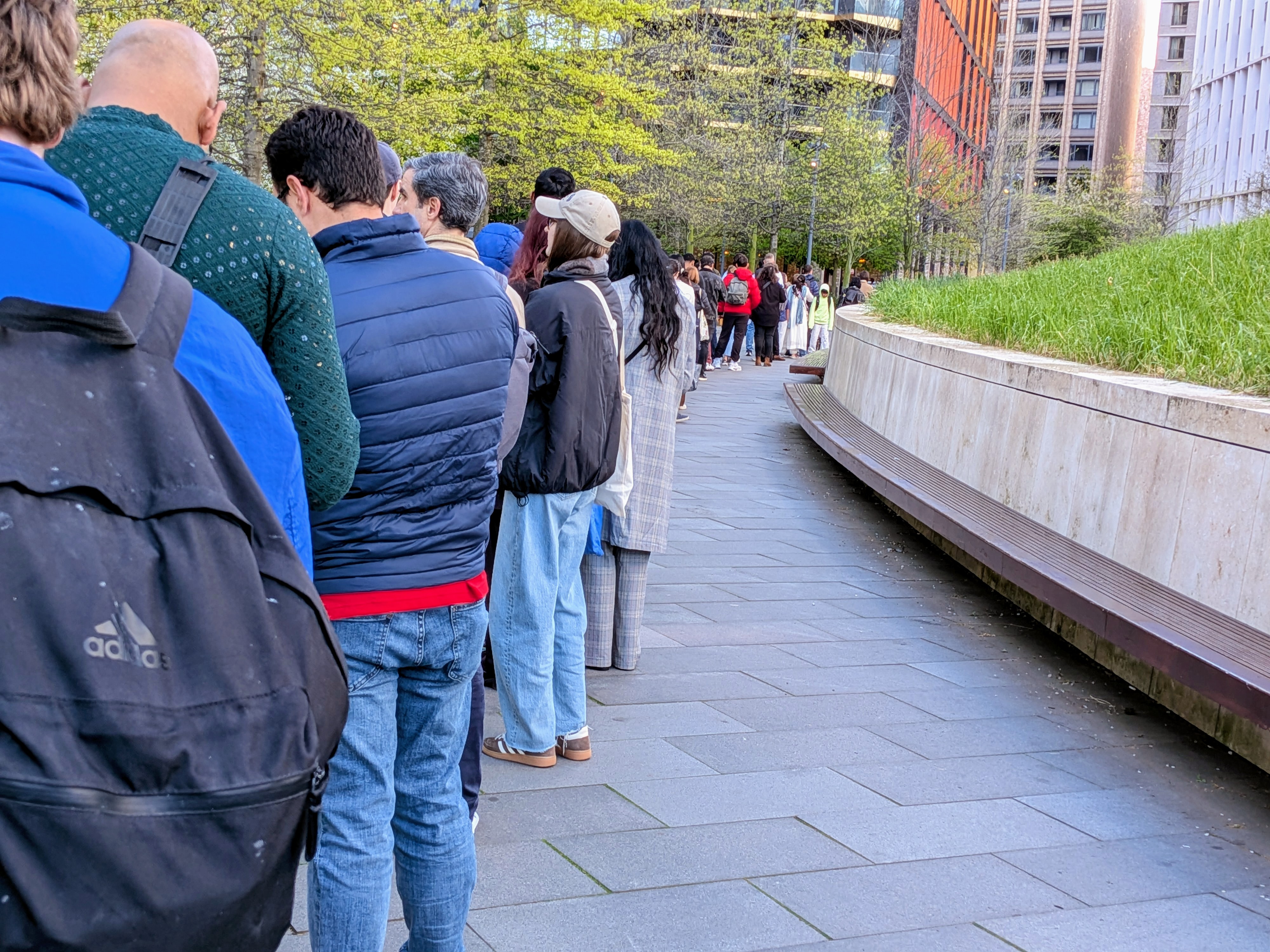
I had prepared carefully and, following the instructions I had found online, paid around £15 for American-format passport photographs measuring exactly two inches by two inches rather than the standard British size.
Then I forgot to bring them.
As I stood inside the embassy, I became increasingly convinced that the entire process might collapse because some small photographs were sitting safely at home. There was a facility inside where photographs could apparently be taken or printed, so I maybe had a backup plan.
Naturally, nobody asked for them.
That became an early lesson in international relocation: the document I worried about would be irrelevant. The harmless-looking document I had left behind would suddenly become essential.
Preparing to Leave
Once the visa had been approved, the process shifted from waiting for permission to dealing with the practical reality of moving.
Two of the most useful things I arranged before travelling were a US telephone number and somewhere to live.
For the phone, I used an eSIM service on my Google Pixel, allowing me to keep my UK SIM while adding an American number. This was enormously useful because I could give a US number to my employer, landlord and various services before I had fully relocated, while still retaining access to my UK number and being able to call home.
Finding an apartment was more a matter of good fortune than careful strategy. A colleague was moving out of a property owned by his landlady, and he put me in contact with her. Although his apartment was not becoming available immediately, she had another unit that was. He viewed it on my behalf, showed me around virtually and sent photographs so that I could make a decision from the UK.
The apartment was in a small multi-family building with three units and, most importantly, had its own laundry facilities. In-unit laundry is apparently something to celebrate enthusiastically in the United States, and I now understand why. It did not have a dishwasher, but that felt like a minor compromise.
The landlady was extremely accommodating, particularly given that I was attempting to rent a property from another country without an American bank account or conventional US credit history.
The main difficulty was paying the deposit.
I had money available through Wise, which is enormously useful for moving funds from the UK. Wise is not technically a bank account; instead, it allows you to hold money in multiple currencies, convert between them and spend using a linked debit card.
That made Wise an excellent bridge between my British and American finances, but it was not a complete substitute for a proper US current (or “checking”) account. Services such as Zelle are normally accessed through a participating bank and require an eligible checking account, so my Wise details did not neatly plug into the payment system my landlady ordinarily used. Venmo can sometimes be linked manually using an account and routing number, but you need a Social Security Number for that (more on that later). In practical terms, I had access to my money and could spend it using my Wise card, but transferring a rental deposit to somebody in the way they expected was surprisingly difficult.
Once again, work came to the rescue and helped to secure the apartment before I arrived. It was a generous and genuinely useful piece of support at a point when the banking system seemed determined to prevent me from paying anybody.
By the time I travelled, I therefore had the beginnings of an American life: a job, an address and a phone number. That was about as far as I could realistically get from the UK.
Crossing the Atlantic
Rather than flying, my sister and I travelled from Southampton to New York aboard the Queen Mary 2.
There were practical reasons for choosing the cruise (or technically Liner). The luggage allowance was effectively limited by how much we could physically carry and squeeze into the cabin, rather than by airline baggage charges. Even then, I somehow managed to arrive feeling that I had packed both far too much and nowhere near enough.
But the journey also felt symbolically appropriate.
After years of uncertainty, visa applications and delayed plans, crossing the Atlantic by ocean liner gave the move a sense of occasion than a normal flight. There was something wonderfully extravagant about leaving England by ship and slowly travelling towards New York rather than simply waking up there several hours after take-off.
The Queen Mary 2 is unashamedly opulent. There are formal dining rooms, lounges, theatres, live music, lectures, afternoon tea and the constant feeling that you should perhaps be wearing something slightly smarter. The extravagance felt fitting for such a major transition in my life, and parts of the voyage were deeply relaxing.
At the same time, it was strangely overwhelming.
Every evening, a programme would arrive setting out the following day’s activities. It consisted of two enormous sides of paper, roughly A3 in British terms or 11 by 17 inches in the United States, filled with events from early morning until late at night. There were talks, performances, quizzes, exercise classes, films, music, dancing and activities I had never previously considered needing on a ship.

I understand why they offer so much. A week at sea is a long time, and nobody wants thousands of passengers complaining that they are bored. The problem was that having so many possibilities created its own sense of pressure. It was easy to feel that there was always another performance to see, another talk to attend or another room you had not yet explored. And trust me, I explored every inch of that ship late into the night for some challenging scavenger hunt!
The journey was therefore relaxing and exhausting at exactly the same time.
Some days felt almost dreamlike: eating an elaborate breakfast, attending a lecture, watching the ocean through the windows and dressing for dinner. Other days, I simply wanted to sleep. By the end of the crossing, despite having had no work and nowhere in particular to be, I felt as though I needed a holiday to recover from the holiday.
Part of that exhaustion was probably emotional. I was not simply taking a cruise; I was leaving my home country, carrying much of my life in suitcases and travelling towards a future that I had spent years imagining without fully knowing what it would be like.
The voyage gave me the rare luxury of a week between two lives. Britain had disappeared behind us, but America had not yet arrived. It was peaceful, celebratory, overwhelming and utterly exhausting, which in hindsight was probably the perfect introduction to the move itself.
Arriving in New York
We arrived at the Brooklyn cruise terminal at 5am on Friday, 3 July. My word was the arrival a glorious sunrise with incredible views over the Hudson River.
At immigration, I presented my passport and H-1B documentation. It was at this point that I realised I had brought a photocopy of my original approval notice rather than the original document. Oh no.
The original was safely stored at home in the UK, protected so carefully from loss that it was now entirely useless.

Fortunately, the immigration officers were eventually able to locate my approval through their systems and confirm that I was authorised to enter under the H-1B. The situation was resolved, although I would strongly recommend that anybody following the same route bring the actual original approval document in their hand luggage.
Once admitted, my arrival was recorded on an electronic document called an I-94. This records the date you entered the country, the immigration status under which you were admitted and the date until which you are authorised to remain.
It is not a particularly impressive-looking document, but it rapidly became one of the most important pieces of paper I possessed. I downloaded and printed it almost immediately.
By this point, I had built up an enormous folder containing virtually every significant document from my adult life: employment letters, insurance policies, education certificates, professional qualifications, visa forms, immigration notices and communications with lawyers. I had initially wondered whether carrying all of it was excessive, but the first few weeks in America quickly taught me that having too much paperwork is far better than standing at a desk without the one document somebody unexpectedly decides they need.
Applying for a Social Security Number
After spending the first weekend arriving and enjoying some time with my sister, my first major administrative priority was obtaining a Social Security number.
The Social Security number is one of the principal keys to American life. It is used for employment records, tax, banking, credit applications and countless identity checks. It is sometimes technically possible to begin a process without one, but almost everything becomes easier once you have it. For the British equivalency think National Insurance Number, however, it only ever exists as a business card sized piece of paper.
On the Monday morning, I went directly to the local Social Security office, unknowingly, without booking an appointment.
The first question I was asked was, naturally, whether I had booked an appointment.
Applicants with appointments were given priority, and I was warned that my number might take some time to appear. I sat down expecting to lose most of the day, although in reality the wait was probably only around an hour or an hour and a half. I should have taken a book, but it was not the ordeal I had anticipated.
When my number was called, the application itself was almost disappointingly simple. I handed over my passport containing the visa, a printed copy of my I-94 and some additional proof of identity and address.
I also had my UK driving licence, employment information and the enormous folder containing anything else they might conceivably request.
Most of it remained untouched.
Some online guidance suggests waiting around ten days after entering the United States before applying for a Social Security number, allowing their archaic immigration systems time to update. I had only been in the country for a few days, but my I-94 was already available online and my arrival could be verified, so there was no difficulty processing the application.
I was told that the card should arrive by the end of the week.
It appeared in the post that Saturday, only five days after I had applied.
After two lottery attempts, nine months of petition processing, an embassy interview, years of planning and a week crossing the Atlantic, my American administrative identity arrived in an ordinary envelope less than a week after I requested it.
For a brief moment, it felt as though the difficult part might be over.
In reality, obtaining the number simply unlocked the next collection of problems: opening a bank account, building a credit history, paying rent and attempting to understand why moving my own money into an American account would sometimes require withdrawing it as cash and handing it back across a counter.
But those are stories for the next post.
 The Damp Patch 🧱