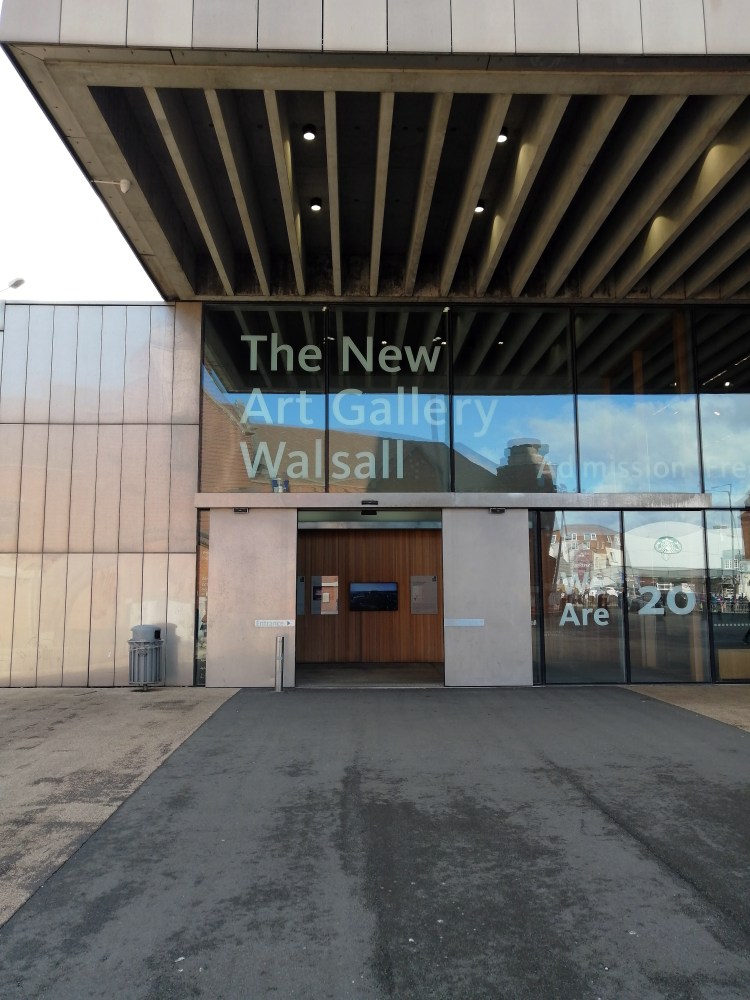
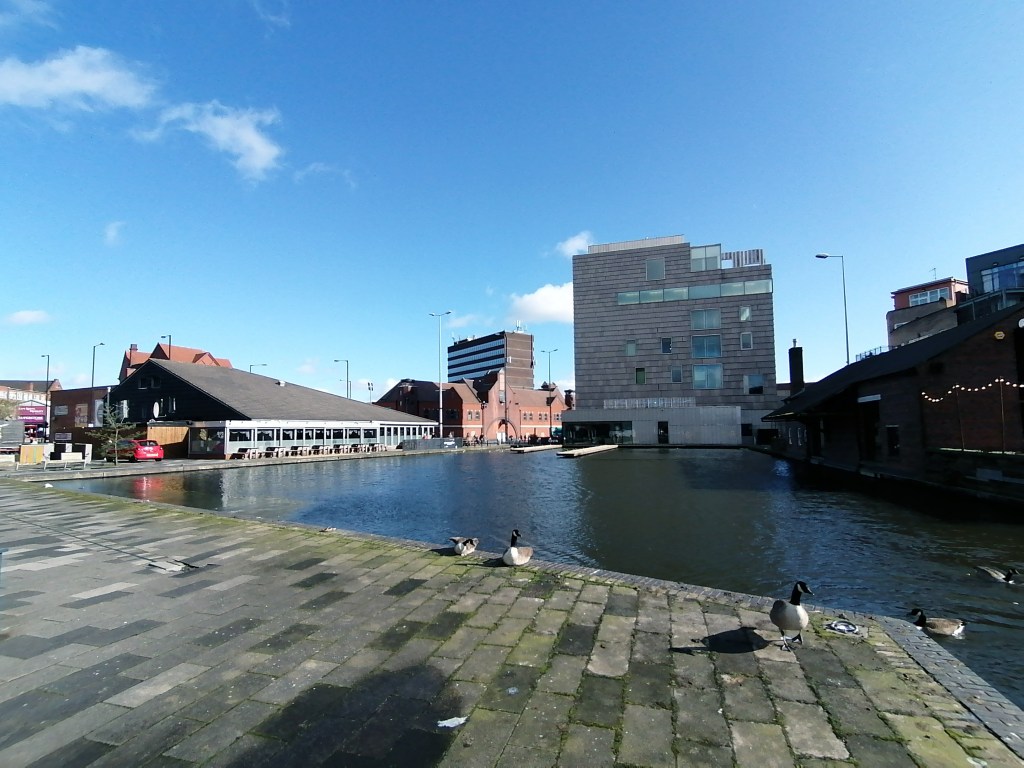
I’ve been kickstarting off 2020 with a series of gallery visits, The Hepworth and Sculpture Park in Wakefield, Salts Mill in Saltaire and this last weekend The New Gallery in Walsall.
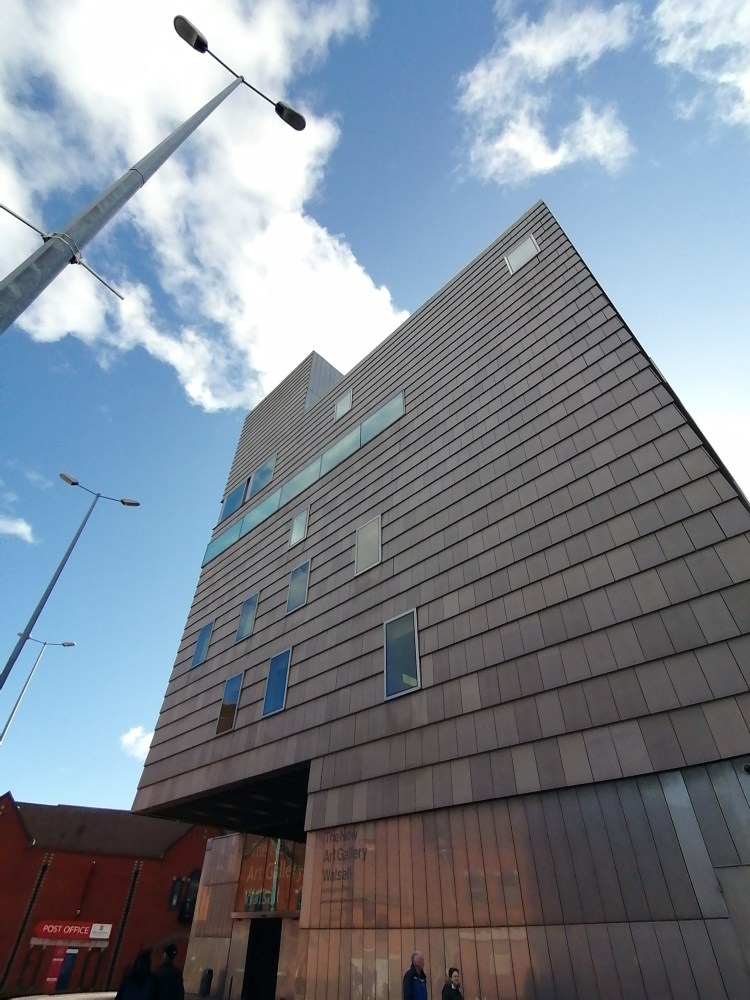
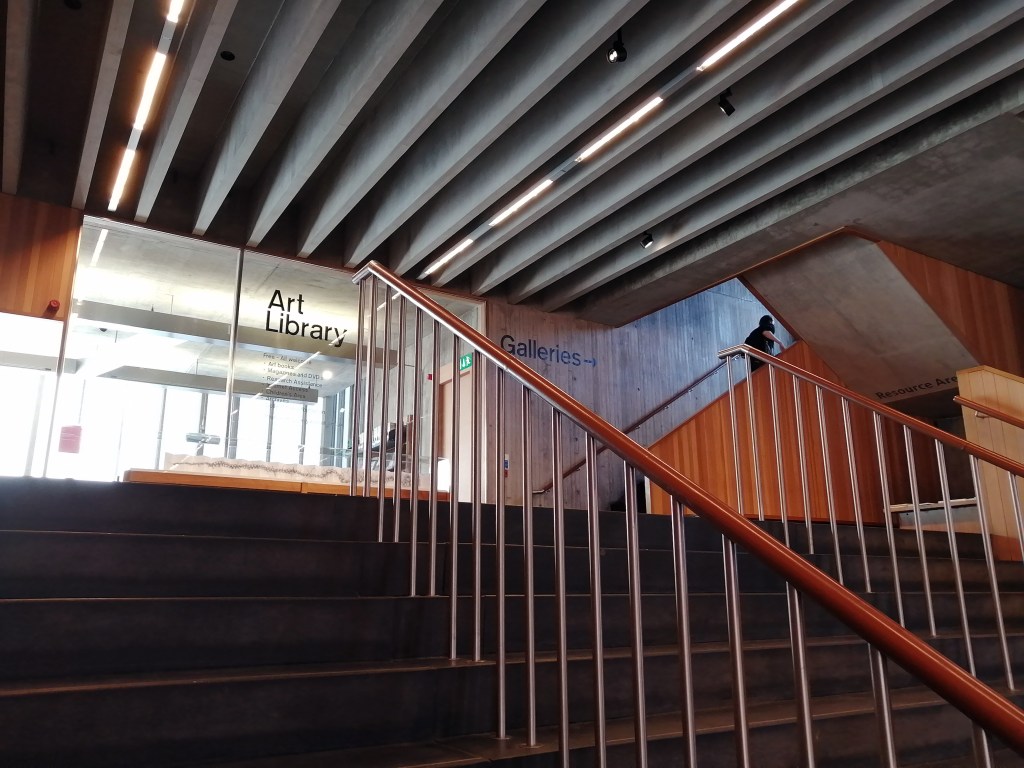
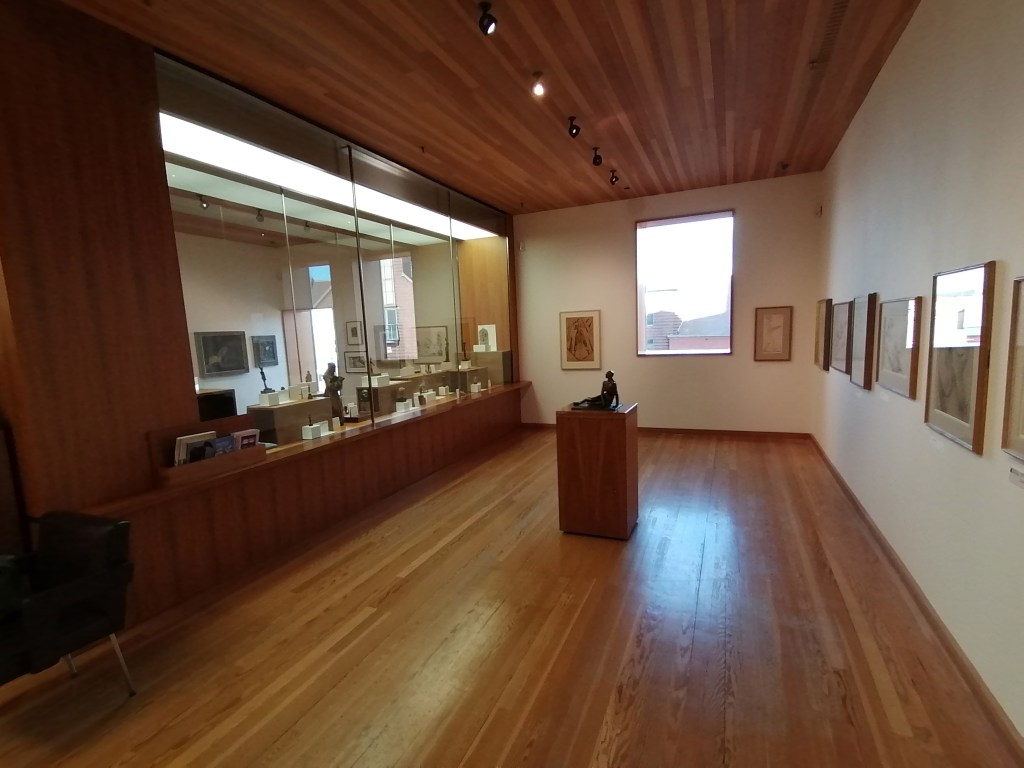
The New Gallery is a stunning contemporary gallery, completed in 2000, they’re celebrating 20 years with 20 pieces of artwork from every year. This is a timeless building that really does not show its age, with beautiful foyer and many gallery spaces. The impression I get is the architect and stakeholders have gained a great balance of the spaces within.
There is a community gallery for everyone on the ground floor with windows opening out onto the street. A permanent gallery of Jacob Epstein’s work, on the middle two floors with timber clad walls and flooring to give it a more homely feeling.
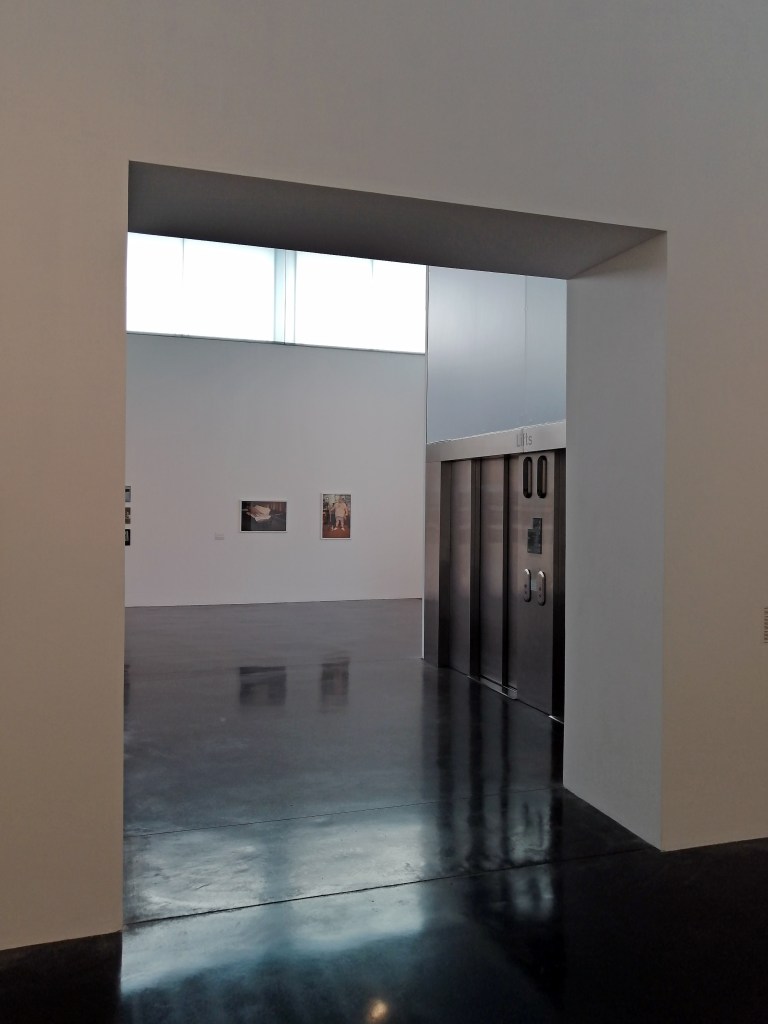
Next floor upwards is a large, multipurpose cliche white gallery. I say cliche as it is the typical blank canvas in which anyone can present any form of art or media. On my visit I discovered a mixed media selling cart with background noises and a full room projection of space and constellations, quite fascinating what contemporary art can be produced.
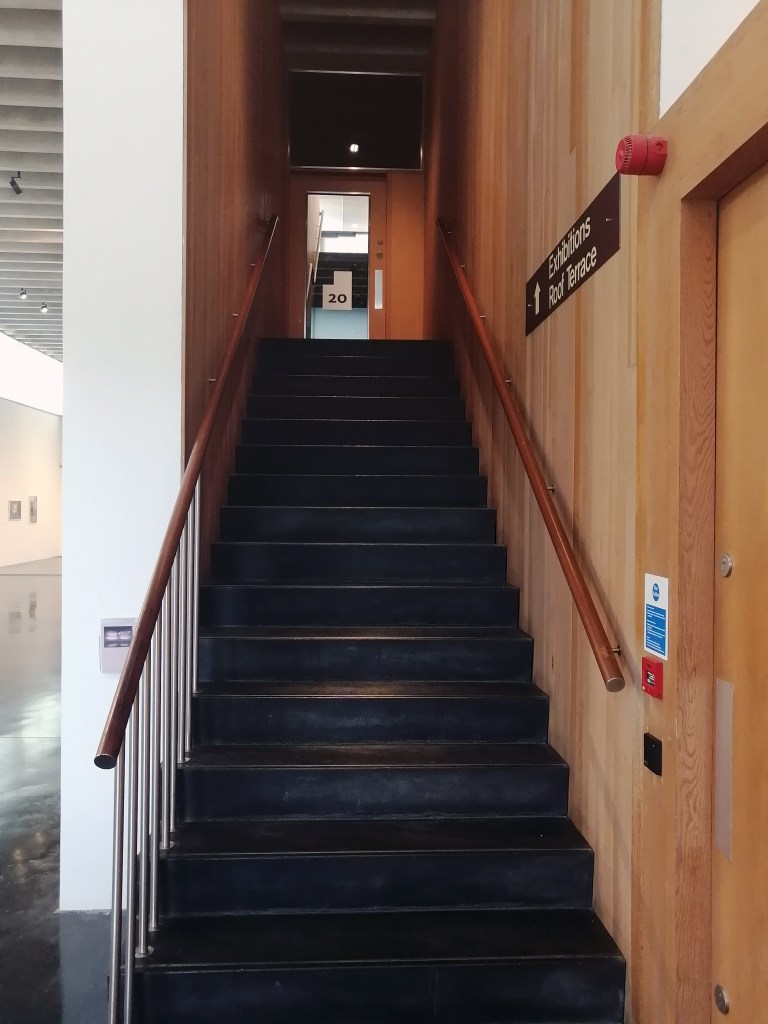
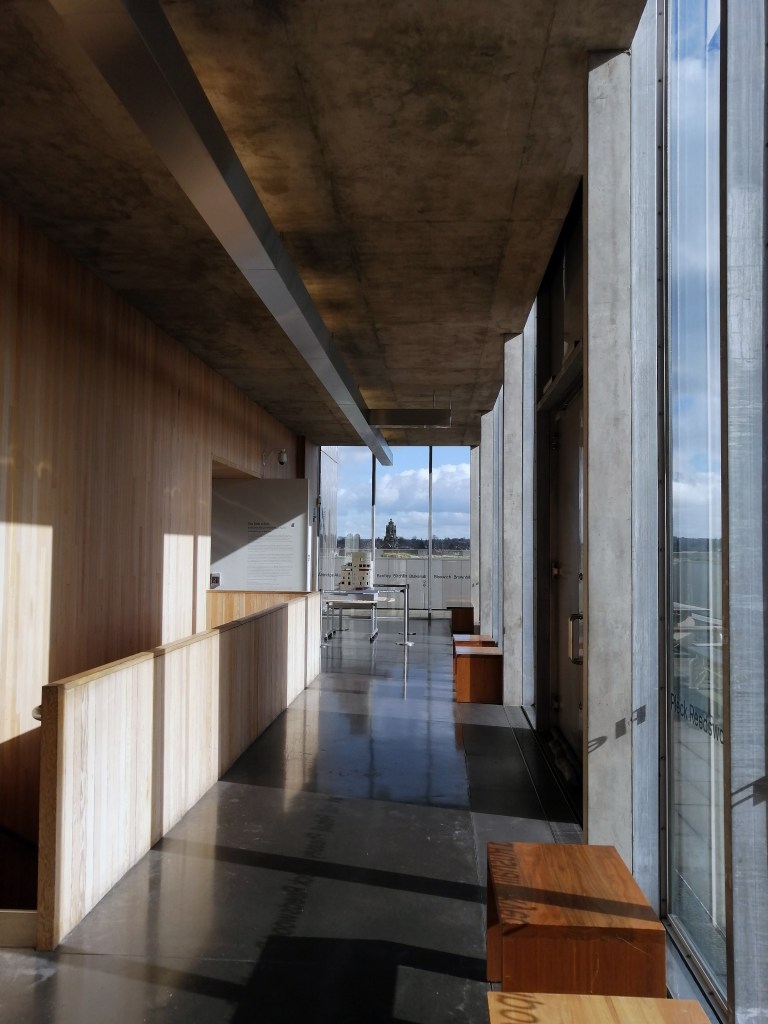
The next floor and at the very top you can find another gallery, which was originally concieved as a restaurant with beautiful large windows overlooking Walsall, but now covered up to create hanging space. The footprint and verticality of the gallery gives it a feeling of The National Gallery but vertical. The typology of the building gives a clever flow of an upwards ascent to be followed by a descent via the lifts.
Overall, I’ve really enjoyed my visit to this gallery and have learnt a lot about how different spaces are composed and the importance of a variety of gallery spaces within one building. I’ve enjoyed the usage of light within the building but am not entirely sold on the external composition of windows. I feel that the internal connection with natural light has taken precedence over the aesthetical design of the external envelope, although this is entirely personal opinion. I would definietly return to experience other artists using the spaces in different ways.
By the end of the last post, I had an apartment, a Social Security number, a bank account, the beginnings of US credit and the foundations of an American life.
What I did not have (and still don’t) was a car.
In Connecticut, that matters rather more than I had appreciated before moving here. You can technically exist without one, but the entire landscape seems to assume that at some point you will give in and buy four wheels. Shops are spread across plazas, errands are measured in driving time rather than walking distance, and even places that look close on a map can be awkward to reach on foot.
So, having finally obtained my Adult Learner’s Permit, the next stage was to work out how to turn that little piece of plastic into actual independence.
Eight Hours of Being Told Not to Crash
The first requirement was an eight-hour safe-driving course.
I had originally hoped to tie this into whichever driving school would eventually take me on for lessons, but availability was limited and the price varied wildly. In the end, I gave up trying to coordinate everything perfectly and booked one of the cheapest courses I could find, around $140 and, crucially had space available.
The course can be taken in evenings, over two four-hour sessions or in one enormous eight-hour block… Naturally I chose the latter.
At 8am on Saturday morning, I logged onto Zoom and proceeded to spend most of the day being taught how now to kill myself or anyone else with a car.
Some of it was genuinely useful; we covered things like driving on ice, and what to do if the car begins to skid and how to react in poor weather, all of which probably has rather more relevance in CT than it did where I learnt to drive.
Most of it can be summarised as:
Do not drink and drive. Do not take drugs and drive. Please never do either of those things. Like ever.
The information would be explained once, then explained again in a slightly different way, followed by a video of someone crashing a car and another explanation of why crashing cars is generally considered undesirable!
I completely understand the importance of road safety… but 8 hours of it?!
The sequence also seems backwards, I had written the knowledge test and issued a learner’s permit, only to then spend an entire day learning about the rules and safety.
Still, I had my next certificate. Another box ticked.
Learning to Drive… Again
The next requirement was actual time behind the wheel with an instructor, which has been unexpectedly difficult to organise. It is summer, so every teenager in CT seems to have the same idea so driving schools are booked out.
I finally have a two-hour mandatory lesson tomorrow. There is something faintly ridiculous about being an experienced driver who has driven across Britain, Europe and the US, but now needs someone to sit beside me and decide whether I understand how the roads work BEFORE I even take the driving test.
The hope is that once the instructor is satisfied I am not a complete liability, I can finally move towards booking the road test.
Everything just seems to take slightly longer than expected.
The Car That Doesn’t Exist
While waiting, I have also been looking at cars. I had assumed somewhere around a $10k mark would be a perfectly respectable used car: nothing glamorous, just reliable enough for work, shopping and weekends away.
This middle ground seems surprisingly difficult to find.
Cars around that price exist, but are often much older, have significantly higher mileage or come with uncertainty that I am reluctant to agree to that large amount of money and hope for the best. It feels like I either need to buy something genuinely cheap and accept the gamble, or stretch the budget.
For now Uber and Lyft have actually worked out at roughly what I had budgeted for owning a car each month. The bigger problem is independence. Every journey has to be planned… and justified… rather than simply hopping in and going.
I hired one again for several days recently just to catch up on errands, meetings and a few social events. It was surprisingly liberating however fleeting.
My other solution is walking, although I may have taken that slightly too far when I decided to walk six miles to the next town and six miles back in around 30°C. Twenty-three thousand steps later, I was reminded why Americans drive everywhere.
Starting to Feel Normal
Despite the continuing transport saga, life is beginning to settle.
Work now feels much more routine, my second paycheck has arrived and the apartment increasingly feels like home rather than somewhere I’ve landed. It still needs artwork and a few finishing touches, although after the amount spent furnishing it, blank walls seem perfectly acceptable.
Socially, things are starting to develop too. We had a happy hour after work, I restarted the office board-game night and I have continued attending a local gaming group. Being in the office physically makes an enormous difference compared with consulting remotely; there are spontaneous conversations, ideas bounced around and all of the little interactions that never happen over Teams.
I am also gradually discovering my local area. One walk I heard someone shouting, thought nothing of it, then received a text from my landlady explaining it was her!
She happened to be renovating another house down the street and spotted me walking past. Inviting me in, it was a rather smarter place than mine but I came away unexpectedly pleased with the little apartment I’ve ended up with.
Same Language, Different Language
The longer I am here, the more I realise that America feels familiar without actually being familiar.
Shopping alone seems to require an entire strategy. Going from store to store often requires an evening planning and searching a route, via food and refreshments en-route. Also, every supermarket (sorry grocery store) requires another app, barcode or digital coupon.
Then when reaching the checkout feels like a roulette wheel of finding out what you are actually going to pay!
That sums up a lot of my experience so far. I moved from an English-speaking country, yet so many ordinary things operate according to slightly different assumptions.
Price excludes tax. Tipping is everywhere. Except when you don’t have to. Credit works differently (so many rewards!). Cars are essential. Prescription drugs are advertised on TV. Returns are incredibly generous, while everything else seems designed to encourage you to buy something else. Why not top up your Amazon basket for FREE delivery, despite paying monthly for free delivery.
It feels like everything has been translated into a language I technically understand, but not quite correctly.
And four weeks into actually living and working here, that strangeness is beginning to sit alongside something else: homesickness.
The first few weeks were too busy to notice. There was always another document, appointment or piece of furniture to sort. More recently, my grandma has been unwell and spent some time in hospital, and that has made being thousands of miles away feel considerably more real.
Fortunately, I am heading back to the UK in a couple of weeks for my mum’s birthday, which I am really looking forward to.
At the moment, I seem to be in this slightly liminal stage where America no longer feels like a holiday, but it does not quite feel like normal life either.
It’s somewhere in between.
Still, with each certificate, paycheck, social event, and slightly ridiculous hurdle, it is beginning to feel more like I’m living a life over here.
There is something quite surreal about being handed the keys to an apartment, opening the door and finding absolutely nothing inside.
I had moved from a fully furnished house in the UK (where years of accumulated possessions had gradually turned a building into a home) to an empty apartment where almost every object I needed had to be deliberately acquired again. A bed, plates, cutlery, chairs, somewhere to work, somewhere to sit, something to cook with; all of the ordinary things you stop noticing once you own them suddenly became individual decisions.
I was reset to square one.
At the same time, it was probably one of the first moments when the move genuinely started to feel real. This was no longer an Airbnb, hotel room or place I was visiting. I had keys. I had an address. The empty rooms were mine to turn into something resembling a home.
The approach quickly became one of good enough for now. Goodwill was particularly useful for that. There is something strangely grounding about standing in a second-hand shop choosing which mismatched plates are going to become your plates. They may not be things I keep forever, but they work, they are mine, and they help turn an empty apartment into somewhere I can actually live.
I Wasn’t Buying Second-Hand
The first major priority was a bed.
There are plenty of things I am perfectly happy buying used, but a mattress was not going to be one of them. The combination of somebody else’s sweat, unknown history and the possibility of bugs was enough to make that decision fairly easy. My sister has had her own experience with bed bugs, and I had absolutely no interest in adding that particular adventure to the relocation story.
The other thing I quickly discovered was that American bed sizing does not map particularly neatly onto British sizing. Broadly speaking, a UK double is closest to a US full-size bed, although I soon found that a full is actually shorter than I was used to. Given that I am already tall enough to notice these things, that was not especially appealing, so I ended up settling on a queen instead, which only just fitted comfortably into the bedroom.
There was also another layer of bed terminology to learn. In the UK, I would generally think of a bed as two main parts: the mattress and the frame. In America, traditional setups often seem to introduce a third component, the box spring, which sits beneath the mattress and then rests on the frame or platform below. One salesman at the more boutique store gave me a very earnest explanation about how the mattress, box spring and frame all needed to work together properly to provide the correct support.
I mostly heard: three things to buy instead of two.
After some Marketplace browsing and trying to work out whether I actually needed the full American bed ecosystem, I decided that a simple white IKEA frame was probably the most sensible answer.
So we went mattress shopping.
We first tried a smaller, more boutique-looking store and tested a few options, including an inflatable bed system that measured your ideal mattress and pillow thickness. However the prices quickly established that it was not really aimed at somebody simultaneously trying to furnish an entire apartment.
That led us to a chain called Mattress Firm.
Yes, I noticed the name too.
We tried a few mattresses and found one I really liked, which included an electronical adjusting basic metal bed frame, which on the whole was a bit of a gimmick. Then we discovered a shop-floor model.
Normally, having just declared that I was absolutely not buying a used mattress, this should probably have disqualified it immediately. But a shop-floor mattress occupies a slightly different category in my head. How many people had actually walked into this fairly random Connecticut mattress store, only opened about a year, chosen this exact model and laid on it for five minutes?
Probably not many.
More importantly, it had been massively reduced.
The sales assistant was delightful, and after talking everything through we told her we would go away, think about it and probably come back later that day or the following morning. Because the mattress had to be paid for in full, we didn’t leave a deposit, although she seemed happy enough that we were intending to return.
So I went back first thing the next morning.
Different salesman. Very different energy.
He immediately seemed unhappy that the mattress had effectively been held without a deposit. Although bear-in-mind I was still the only person I saw in that store. Then, as he started putting everything through the system, there was a pause.
“Urm… you’re not going to like this.”
Apparently, he could not sell me the mattress for the price written on the label.
My response was: What?
A manager was called. Some discussion followed. It turned out the advertised price was actually lower than the amount Mattress Firm had originally paid for the mattress, and company policy prevented them from selling below cost.
Unfortunately for them, I had taken a photograph of the price displayed in the store.
After a little more back and forth, they honoured it (or honored I should say).
It was only when I eventually saw the invoice that I realised quite how ridiculous the deal had been: a mattress originally worth more than $1,000 for about $275.
Sometimes moving country apparently involves paperwork, immigration lawyers and government departments. Sometimes it involves accidentally defeating the pricing system at Mattress Firm. Also as an aside, the US is much more of a coupon or discount driven shopping experience, but much more on that later.
Connecticut also introduced me to another new concept: a mattress recycling fee. When you buy a mattress, you pay a $16 fee upfront that contributes towards its eventual recycling whenever, presumably many years later, you decide to get rid of it.
It is probably quite a sensible system.
It just feels peculiar to be paying for the disposal of something before you have even slept on it. A little nihilistic, really.
Building the Rest of the Apartment
Once the bed was sorted, the rest of the apartment could gradually follow.
A table and some chairs were fairly high on the list because I needed somewhere to eat and, more importantly, somewhere to work. My landlady had very kindly provided a few basic pans and kitchen essentials, which meant I did not have to build the kitchen completely from zero. She had also provided an airbed, which was incredibly useful while my sister was staying because it meant one of us could use the new mattress while the other still had somewhere vaguely respectable to sleep.
There were plenty of Goodwill trips, an IKEA trip (or trips once I found out I’d picked up the wrong size bed frame!) and visits to various stores looking for whatever happened to be next on the list.
I also went backwards and forwards on whether to buy a television.
A TV is clearly not an essential item when you have just moved country. You can survive very happily without one. On the other hand, I do watch quite a lot of television when I am relaxing at home, and the World Cup happened to be on at the time, which was an extremely convenient argument in favour of buying one.
I eventually discovered that some of the larger electronics stores sell open-box televisions for roughly what people were asking for used ones online. To me, that seemed a much better deal: similar money, but with the reassurance of buying through a proper store and retaining some form of guarantee.
Then you notice that going slightly larger costs only a little more.
And then slightly larger than that is only a little more again.
I may have gone slightly too large.
The whole setup process became a balance between trying not to waste money and recognising that I actually needed things in order to live comfortably. I needed somewhere to sleep, somewhere to work, somewhere to sit and enough kitchen equipment to feed myself. I could technically have survived with much less, but I did not want every evening after work to become another reminder that my life was still sitting half-unpacked in boxes.
Looking back at the total amount I spent setting everything up was slightly alarming. I almost certainly spent more than I imagined I would before moving.
But there is another side to that.
Much of what I bought retains some resale value. More importantly, most people who have visited the apartment have been genuinely surprised by how quickly it has become properly furnished and comfortable. Given the uncertainty surrounding when I would have a car and how easily I would be able to get around afterwards, there was something reassuring about getting as much sorted as possible while I still had transport.
I think, subconsciously, I wanted the apartment to stop feeling temporary as quickly as possible.
My advice to anyone planning a wholesale move like this would be to think realistically about what it will cost to make a new apartment genuinely liveable, and then build in a healthy buffer beyond that. It is very easy to budget for rent and a few obvious pieces of furniture without accounting for the dozens of smaller things that quickly add up. Cash flow matters too: at the time of writing, I have been in the US for an entire month but have only received one week’s worth of pay, simply because of when I started and how the payroll cycle fell. Having enough money set aside to absorb that gap has made the whole process considerably less stressful.
Shopping in America is an Expedition
One of the stranger adjustments has been discovering how exhausting basic errands can be in America.
Back in the UK, if I needed several different things I could often walk into town and cover multiple shops within a relatively small area. Even where the traditional high street has declined, the basic concept remains: park once and move between shops. If I wanted a different selection I’d go to the next town or city over.
That is not how much of suburban America works.
Here, you drive to one shopping plaza for one store, get back into the car, drive to another plaza, park again, buy the next thing, return to the car and repeat.
Even shops located within what appears to be the same shopping plaza can be far enough apart that you end up driving between them.
During one Saturday with the rental car, I think I visited three different Goodwill stores and nearly ten shops in total. By the end of the day, it felt less like shopping and more like some sort of endurance event. I literally packed sandwiches and snacks for the road because I knew it’d be an all day event.
There are bargains to be found, though. American retail seems to operate in a permanent state of discounting, clearance and promotional pricing. You can find something surprisingly expensive at full price sitting next to something inexplicably cheap. Oh and why not throw another 15% off because why not. And a $5 coupon for your phone, yes sure why not!
The other adjustment is that the price you see on the shelf is rarely the amount of money that leaves your account. Sales tax gets added afterwards.
Then, depending on what you are buying or where you are, there may be a tip.
Something advertised as $10 has an uncanny ability to become $12, $13 or $15 by the time the transaction is actually finished.
Coming from England, where the price displayed generally includes VAT and is therefore the price you pay, it takes a little getting used to.
Existing Financially Before You Have a Bank
Fortunately, I had prepared reasonably well for spending money before obtaining an American bank account. Wise, which I had already used to move money into dollars before arriving, became my main bridge between the UK and US systems.
The virtual Wise card on my phone was particularly useful. Anywhere offering contactless payment, I could simply tap my phone and spend directly from my US-dollar balance as though I already had an American debit card.
The only problem is that America has a slightly inconsistent relationship with contactless payments. In shops it generally works well, but restaurants still quite commonly take your physical card away to process the payment. A virtual card sitting inside my phone is not tremendously useful when somebody wants to walk off with a piece of plastic.
Wise would happily have sent me a physical card. I simply forgot to order one.
Between that and a couple of UK cards with no foreign transaction fees, I was never actually unable to spend money. But Wise still had its limits. It was an excellent way of holding, spending and transferring dollars, but it could not completely replace being an established customer of an American bank.
And America really likes you to be an established customer of an American bank.
Becoming an American Bank Customer
My Social Security card arrived on the Saturday after I applied for it. The following Monday, I went to Chase.
Opening the account felt like a surprisingly significant milestone. Until then, I was living in America but financially operating around the edges of it. Once the checking and savings accounts were set up, I could finally receive my salary, pay bills in the normal way and most importantly pay my landlady without inventing increasingly creative methods of transferring money (or so I thought).
One important detail for anybody moving from Britain: Chase UK and Chase US may share a name, but for practical purposes they are completely separate institutions.
Having a Chase account in England did not give me any useful shortcut into the American system.
They even have separate apps, which are helpfully almost identical except that one is blue-on-white and the other white-on-blue.
Setting up the accounts took somewhere around an hour or an hour and a half, and then we encountered another problem.
To complete the credit-card application, I needed at least $250 in my new checking account.
Fine. I had money. I had a UK Chase debit card.
Surely I could simply transfer $250 from one account called Chase into another account called Chase while physically sitting inside a Chase branch?
Apparently not.
The teller could not process my British card because the payment system required a US billing address. There was no contactless option available either.
Eventually, I walked back out into the foyer, put the exact same debit card into the ATM, withdrew $250 in cash, carried the cash approximately twenty feet back to the teller and handed it over.
He then deposited it into my new account. Technically, the system had been satisfied.
It may be the most unnecessarily physical bank transfer I have ever completed.
My Glorious $500 of American Credit
Alongside the checking and savings accounts, I applied for a Chase Freedom Rise credit card.
This is essentially designed for people with little or no credit history, young adults, students and, apparently, thirty-year-old immigrants who can demonstrate years of perfect financial behaviour in another country but have had the audacity to arrive in America without bringing their credit score with them.
I was approved.
Credit limit: $500.
Honestly, $500 is almost comically useless when you are furnishing an apartment.
The card earns 1.5% cashback, which is actually quite good, so naturally I want to put as much normal spending through it as possible. Unfortunately, it does not take very long to reach a $500 limit when buying groceries, furniture and various household essentials. Plus a mini-holiday, car rentals and excursions…
I therefore keep using it, reaching the limit, manually paying it down and then using it again.
Because of how the first billing cycle has fallen, the normal automatic payment apparently will not properly kick in until September, giving me roughly six weeks of manually clearing the balance myself.
It is slightly ridiculous, but it is also doing exactly what I need it to do: beginning to create a credit history.
That is another strange part of emigrating. I have a perfect credit history in Britain. I have had credit cards for years, paid bills on time and have an established financial life.
In America, none of that really exists. I am effectively a financial newborn.
Zelle: Because Paying Rent Needed Another Obstacle
Having a US bank account did at least mean I could finally use Zelle, which is one of the main ways people transfer money directly between bank accounts here.
My landlady uses it for rent, so this should have solved the payment problem completely.
Naturally, it did not.
As a new Chase customer, my initial Zelle transfer limit was only $500 per day.
My rent was considerably more than $500.
Even better, because I did not yet have an American photo ID that the system could scan, all transfers require additional identity verification by telephone.
One evening I tried to pay the rent and was placed into a telephone queue with an estimated wait of around forty minutes. I gave up.
On other occasions, I got through relatively quickly and was able to verify the payment. My transfer limit has since increased to around $2,000, which at least means the rent can now be sent in one transaction, although I still have to telephone to prove that I am, in fact, the person attempting to give my own money to my own landlady.
It has become easier.
But that first successful rent payment felt like another disproportionately important achievement.
The Amex Problem
One financial setback that annoyed me more than I expected involved American Express. Yes I will call them out here.
I have been an Amex customer in the UK for years. I have an excellent credit record there and had assumed that this established relationship might make moving into the American credit system slightly easier.
Amex actually offers something called Global Transfer, specifically designed to help existing international customers apply for a card when moving country.
Unfortunately, somewhere between my research, their website, multiple phone agents and the application process, I managed to apply through the normal American route instead.
From the perspective of that system, the application probably looked absurd:
I had barely been in the country a week.
My US bank account was brand new.
I had no established American credit score.
So they declined me.
Which is completely logical if you ignore the fact that I had already been their customer for years somewhere else.
I later tried to go through the correct Global Transfer process, but that has not exactly gone smoothly either. I have finally received a formal rejection letter, so the next stage is to telephone them and try to untangle what has happened.
Naturally, their customer-service hours largely overlap with the hours when I am supposed to be at work. Another problem for another day.
When Visiting Became Living
Somewhere amongst the furniture, bank accounts and paperwork, there was also a more subtle change taking place.
For the first couple of weeks, having my sister with me made the whole experience feel slightly like an extended trip. We had crossed the Atlantic together, gone shopping together and then spent a week driving around New England. There was always another destination, another store or another thing to arrange.
Then, on the Saturday night before I started work, I dropped her off at the airport.
It was relatively late by the time I began the long drive home.
That journey felt different.
There was no sightseeing planned for the following day. Nobody was staying with me. The holiday part was finished.
I drove back to my apartment, sat down and had the rather stark realisation that this was now simply my life.
Work started next.
The first day itself was strangely normal. I already knew the company and most of the people because I had worked with them remotely for so long, but there was still something surreal about physically making the journey into the office, coming home again that evening and realising that this commute was going to repeat itself over and over.
However long I remain here, for now this is home.
Receiving the Social Security card had felt like an official milestone. Opening the bank account had made me financially functional. Paying rent made the apartment feel properly mine.
But driving home alone that first weekend was probably the moment when everything shifted from moving to America to living in America.
The exciting part is that things were coming together.
The slightly less exciting part was that another major piece of American life was still missing.
A car.
And, as I was discovering, Connecticut was not going to make getting one particularly straightforward.
When I first began looking seriously into moving from the United Kingdom to the United States, I expected to find plenty of practical accounts from people who had already done it. Glorious blogs and how-to guides abound. There are, of course, countless official websites explaining visa categories, application forms and documentary requirements, but I found surprisingly little about what the experience actually feels like when you are the person trying to dismantle one life and establish another.
The official guidance can tell you which form to submit (sometimes), but it does not necessarily explain how to rent an apartment without an American bank account, how to open a bank account without a Social Security number, or how to prove your identity when every organisation seems to require a different combination of documents. It certainly does not prepare you for the strange experience of being a competent, independent adult in one country and then arriving somewhere new where even paying rent or obtaining a phone contract can feel like an administrative puzzle.
My own circumstances are admittedly quite specific. I moved to Connecticut on an H-1B visa to work for a company I had already been consulting with from the UK for around two years. That familiarity made the professional side of the move much easier because I already knew the company, understood the work and had existing relationships with the people there.
In most other respects, however, I was working things out largely solo.
My friends and family were incredibly supportive, but none of us had done anything quite like this before. I do not have American family guiding me through the system, an experienced expatriate who could tell me what to expect, or a relocation company arranging housing, banking and transport on my behalf. Most of the time, I was reading contradictory advice online, collecting more documents than any sensible person should need and making my best guess about what would happen next.
Perhaps I should have found more support beforehand, although I also feel that moving country should not require knowing somebody who has already solved every problem for you. Hopefully, by writing honestly about my own experience, I can provide at least a little of that support for somebody else.
My sister recently asked how I manage not to worry about everything involved in setting up a life in the United States. The truth is that I can usually only control the next one or two steps; beyond that, I am often waiting for somebody else to tell me what happens next.
Winning the Lottery Is Only the Beginning
The H-1B process begins with an annual lottery.
I was unsuccessful the first time I entered and extraordinarily fortunate to be selected on my second attempt in 2025. One of the first things to understand is that selection does not mean you have been granted a visa. It simply means that your employer has been given permission to submit an application on your behalf.
I was selected in March, after which the company and its immigration lawyer began assembling the application for submission before the end of June. The company handled its side efficiently, and the lawyer was thorough in gathering information about my qualifications, experience and proposed role. I had to submit everything about my life, education and work to a company who would provide a very official looking report that would demonstrate to the US Government who I am. Everything initially appeared to be progressing as expected.
Then came silence.
Complete and utter silence.
The earliest theoretical start date for that year was the 1st October, so I had begun arranging my life around the assumption that I might be moving in the autumn. I was mentally preparing to leave the UK, adjusting work commitments and imagining what it would be like to arrive in Connecticut just as the seasons changed. I was packing boxes, aiming for winter clothes and boots.
October arrived without a decision.
Then November passed, followed by Christmas and the beginning of another year. I was living in a strange state of suspension, preparing to leave without knowing when; or, realistically, whether I would actually be allowed to go.
The approval eventually arrived the following March, almost nine months after the petition had been submitted. Funnily enough on my actual birthday… how bizarre!
It was a tremendous relief, but even then I did not technically have a visa. I had received approval to proceed to the next stage, which meant applying for the visa stamp and attending an interview at the United States Embassy in London.
The Embassy Interview
My embassy appointment was early in the morning, and the experience felt somewhere between airport security and administrative livestock management. Applicants moved between queues and counters, presented documents and waited for their numbers to appear.
The interview itself was far less dramatic than I had imagined. I was asked who I was, what I did, which company was employing me, why I was suited to the role and why I was moving to the United States. The questions were sensible, although the overall process remained slightly mysterious, as immigration procedures often seem to be.
I had prepared carefully and, following the instructions I had found online, paid around £15 for American-format passport photographs measuring exactly two inches by two inches rather than the standard British size.
Then I forgot to bring them.
As I stood inside the embassy, I became increasingly convinced that the entire process might collapse because some small photographs were sitting safely at home. There was a facility inside where photographs could apparently be taken or printed, so I maybe had a backup plan.
Naturally, nobody asked for them.
That became an early lesson in international relocation: the document I worried about would be irrelevant. The harmless-looking document I had left behind would suddenly become essential.
Preparing to Leave
Once the visa had been approved, the process shifted from waiting for permission to dealing with the practical reality of moving.
Two of the most useful things I arranged before travelling were a US telephone number and somewhere to live.
For the phone, I used an eSIM service on my Google Pixel, allowing me to keep my UK SIM while adding an American number. This was enormously useful because I could give a US number to my employer, landlord and various services before I had fully relocated, while still retaining access to my UK number and being able to call home.
Finding an apartment was more a matter of good fortune than careful strategy. A colleague was moving out of a property owned by his landlady, and he put me in contact with her. Although his apartment was not becoming available immediately, she had another unit that was. He viewed it on my behalf, showed me around virtually and sent photographs so that I could make a decision from the UK.
The apartment was in a small multi-family building with three units and, most importantly, had its own laundry facilities. In-unit laundry is apparently something to celebrate enthusiastically in the United States, and I now understand why. It did not have a dishwasher, but that felt like a minor compromise.
The landlady was extremely accommodating, particularly given that I was attempting to rent a property from another country without an American bank account or conventional US credit history.
The main difficulty was paying the deposit.
I had money available through Wise, which is enormously useful for moving funds from the UK. Wise is not technically a bank account; instead, it allows you to hold money in multiple currencies, convert between them and spend using a linked debit card.
That made Wise an excellent bridge between my British and American finances, but it was not a complete substitute for a proper US current (or “checking”) account. Services such as Zelle are normally accessed through a participating bank and require an eligible checking account, so my Wise details did not neatly plug into the payment system my landlady ordinarily used. Venmo can sometimes be linked manually using an account and routing number, but you need a Social Security Number for that (more on that later). In practical terms, I had access to my money and could spend it using my Wise card, but transferring a rental deposit to somebody in the way they expected was surprisingly difficult.
Once again, work came to the rescue and helped to secure the apartment before I arrived. It was a generous and genuinely useful piece of support at a point when the banking system seemed determined to prevent me from paying anybody.
By the time I travelled, I therefore had the beginnings of an American life: a job, an address and a phone number. That was about as far as I could realistically get from the UK.
Crossing the Atlantic
Rather than flying, my sister and I travelled from Southampton to New York aboard the Queen Mary 2.
There were practical reasons for choosing the cruise (or technically Liner). The luggage allowance was effectively limited by how much we could physically carry and squeeze into the cabin, rather than by airline baggage charges. Even then, I somehow managed to arrive feeling that I had packed both far too much and nowhere near enough.
But the journey also felt symbolically appropriate.
After years of uncertainty, visa applications and delayed plans, crossing the Atlantic by ocean liner gave the move a sense of occasion than a normal flight. There was something wonderfully extravagant about leaving England by ship and slowly travelling towards New York rather than simply waking up there several hours after take-off.
The Queen Mary 2 is unashamedly opulent. There are formal dining rooms, lounges, theatres, live music, lectures, afternoon tea and the constant feeling that you should perhaps be wearing something slightly smarter. The extravagance felt fitting for such a major transition in my life, and parts of the voyage were deeply relaxing.
At the same time, it was strangely overwhelming.
Every evening, a programme would arrive setting out the following day’s activities. It consisted of two enormous sides of paper, roughly A3 in British terms or 11 by 17 inches in the United States, filled with events from early morning until late at night. There were talks, performances, quizzes, exercise classes, films, music, dancing and activities I had never previously considered needing on a ship.
I understand why they offer so much. A week at sea is a long time, and nobody wants thousands of passengers complaining that they are bored. The problem was that having so many possibilities created its own sense of pressure. It was easy to feel that there was always another performance to see, another talk to attend or another room you had not yet explored. And trust me, I explored every inch of that ship late into the night for some challenging scavenger hunt!
The journey was therefore relaxing and exhausting at exactly the same time.
Some days felt almost dreamlike: eating an elaborate breakfast, attending a lecture, watching the ocean through the windows and dressing for dinner. Other days, I simply wanted to sleep. By the end of the crossing, despite having had no work and nowhere in particular to be, I felt as though I needed a holiday to recover from the holiday.
Part of that exhaustion was probably emotional. I was not simply taking a cruise; I was leaving my home country, carrying much of my life in suitcases and travelling towards a future that I had spent years imagining without fully knowing what it would be like.
The voyage gave me the rare luxury of a week between two lives. Britain had disappeared behind us, but America had not yet arrived. It was peaceful, celebratory, overwhelming and utterly exhausting, which in hindsight was probably the perfect introduction to the move itself.
Arriving in New York
We arrived at the Brooklyn cruise terminal at 5am on Friday, 3 July. My word was the arrival a glorious sunrise with incredible views over the Hudson River.
At immigration, I presented my passport and H-1B documentation. It was at this point that I realised I had brought a photocopy of my original approval notice rather than the original document. Oh no.
The original was safely stored at home in the UK, protected so carefully from loss that it was now entirely useless.
Fortunately, the immigration officers were eventually able to locate my approval through their systems and confirm that I was authorised to enter under the H-1B. The situation was resolved, although I would strongly recommend that anybody following the same route bring the actual original approval document in their hand luggage.
Once admitted, my arrival was recorded on an electronic document called an I-94. This records the date you entered the country, the immigration status under which you were admitted and the date until which you are authorised to remain.
It is not a particularly impressive-looking document, but it rapidly became one of the most important pieces of paper I possessed. I downloaded and printed it almost immediately.
By this point, I had built up an enormous folder containing virtually every significant document from my adult life: employment letters, insurance policies, education certificates, professional qualifications, visa forms, immigration notices and communications with lawyers. I had initially wondered whether carrying all of it was excessive, but the first few weeks in America quickly taught me that having too much paperwork is far better than standing at a desk without the one document somebody unexpectedly decides they need.
Applying for a Social Security Number
After spending the first weekend arriving and enjoying some time with my sister, my first major administrative priority was obtaining a Social Security number.
The Social Security number is one of the principal keys to American life. It is used for employment records, tax, banking, credit applications and countless identity checks. It is sometimes technically possible to begin a process without one, but almost everything becomes easier once you have it. For the British equivalency think National Insurance Number, however, it only ever exists as a business card sized piece of paper.
On the Monday morning, I went directly to the local Social Security office, unknowingly, without booking an appointment.
The first question I was asked was, naturally, whether I had booked an appointment.
Applicants with appointments were given priority, and I was warned that my number might take some time to appear. I sat down expecting to lose most of the day, although in reality the wait was probably only around an hour or an hour and a half. I should have taken a book, but it was not the ordeal I had anticipated.
When my number was called, the application itself was almost disappointingly simple. I handed over my passport containing the visa, a printed copy of my I-94 and some additional proof of identity and address.
I also had my UK driving licence, employment information and the enormous folder containing anything else they might conceivably request.
Most of it remained untouched.
Some online guidance suggests waiting around ten days after entering the United States before applying for a Social Security number, allowing their archaic immigration systems time to update. I had only been in the country for a few days, but my I-94 was already available online and my arrival could be verified, so there was no difficulty processing the application.
I was told that the card should arrive by the end of the week.
It appeared in the post that Saturday, only five days after I had applied.
After two lottery attempts, nine months of petition processing, an embassy interview, years of planning and a week crossing the Atlantic, my American administrative identity arrived in an ordinary envelope less than a week after I requested it.
For a brief moment, it felt as though the difficult part might be over.
In reality, obtaining the number simply unlocked the next collection of problems: opening a bank account, building a credit history, paying rent and attempting to understand why moving my own money into an American account would sometimes require withdrawing it as cash and handing it back across a counter.
Thermal bridging is one of those quiet realities of building science, invisible until it isn’t. It’s the weak point in a wall, floor, or roof, where heat finds the path of least resistance and slips away. Sometimes it’s accidental, a screw in the wrong place. More often, it’s a consequence of poor detailing or a junction that wasn’t quite thought through.
In practice, I’ve found it appears most often where materials or geometries converge: the floor-to-wall junction, the eaves, or around window frames. These are the areas that look neat on a drawing but reveal their flaws when condensation, or worse, mould begins to form.
Illustration of a THERM model demonstrating the layers within a thermal bridging calculationVisual representation of thermal bridging, illustrating heat flow pathways in building junctions.
In the UK, we’ve become almost obsessive about these small thermal leaks. Our regulations demand that we not only acknowledge them but measure them. Every new dwelling requires a SAP energy model, which explicitly accounts for thermal bridges through psi-values (ψ-values), those fractional losses that define the efficiency of a home.
For commercial buildings, we use SBEM (Simplified Building Energy Model) and yes, it is mandatory for compliance with Part L of the Building Regulations. Across the Atlantic, the US is a different phase of the same conversation. Codes like ASHRAE 90.1 and the IECC exist, but most projects still demonstrate compliance through an R-value method; a simple averaging of insulation layers to reach a total thermal resistance.
That’s slowly changing. Some projects in Massachusetts is adopting “stretch” and “specialized” energy codes, which replace this broad-brush R-value method with the U-factor approach already familiar in the UK and Europe. The newer standards consider the real-life interruptions in the building’s thermal blanket and ensure proper detailing.
The difference between the two countries isn’t just how they calculate performance, its in how they build for it.
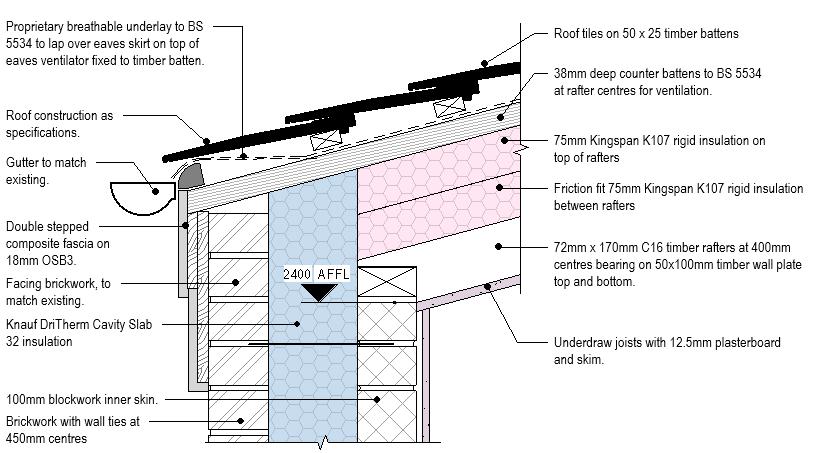
In the UK, our cavity wall system has long been the unsung hero of energy efficiency. Two solid leaves of masonry with a continuous layer of insulation between. A pragmatic and durable solution. But as regulations tighten, the cavity is widening; from 100mm (4”) to 150mm (6”) in many cases. The walls grow thicker, the sites grow smaller, and the details become more complicated. Even the humble thermal cavity closer is now required in new, wider formats.
UK brick and block eaves detail with full fill cavity insulation
In the US, construction has historically favoured the timber stud wall, fully filled with insulation. It’s quick and economical, but thermal continuity stops at every stud. The push for continuous insulation is gaining traction but brings its own set of challenges. Different windows, specialist fixings, high costs, and reluctant contractors make it a slow revolution.
US 2×6 stud eaves detail with continuous insulation
Thermal bridging is rarely felt directly. Most occupants won’t notice the bridge itself, they’ll notice what follows is a chilly patch on the wall, higher heating bills, or worse-case mould. It’s a practical comfort problem, not just theoretical.
In the UK, with higher energy costs and a national focus on decarbonisation, thermal performance has become part of architectural identity. We speak of U-values and airtightness as easily as form and proportion. In the US, where energy is cheaper and climates wildly varied, the urgency differs. Some regions battle to keep heat in, others to keep it out. “Cold bridging” doesn’t quite fit when the challenge might be just as easily be solar gain.
For all its science, the phrase thermal bridging has always felt poetic to me. It’s about connection and consequence. A bridge can unite or it can leak. It can carry the flow of heat, or the flow of ideas between two ways of building.
In my work, I see the literal and figurative bridges everywhere: between cost and performance, between detail and construction, between architect and builder. Sometimes the connections are strong and efficient; sometimes they bleed energy and understanding alike.
To design better buildings we need fewer gaps, both thermal and professional.
I never expect that the first cultural difference of working between the two countries would focus on bathrooms but this is the Damp Patch.
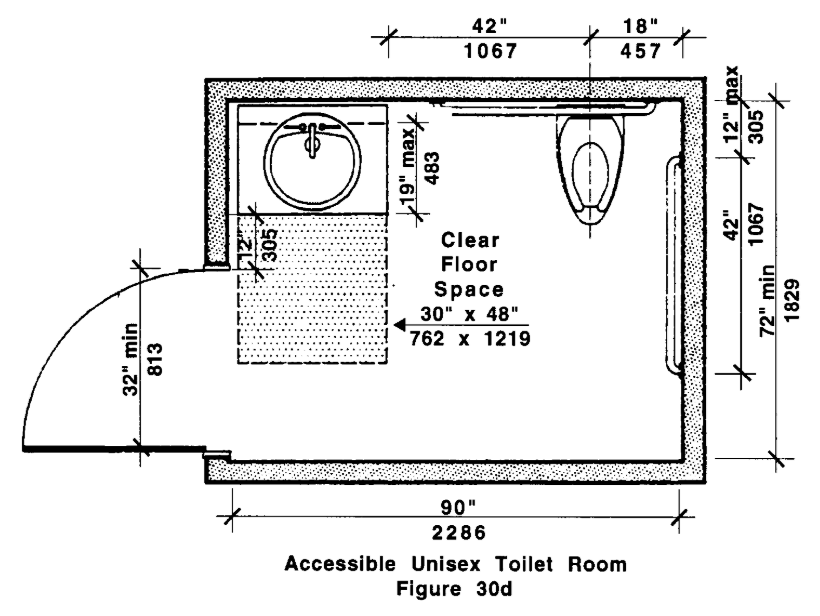
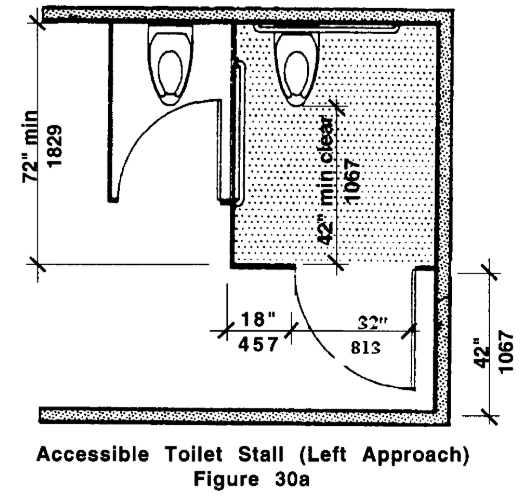
Coming from the UK, where a compliant fully accessible WC is a snug 2.2m x 1.5m (7′-3” x 4′-11”) box of pure function, comparing to my first Massachusetts project felt like an indulgence: a 90in x 72in (2286mm x 1829mm) room that could almost pass for a small bedroom. You can basically swing a cat in it! But the real differences lie not in size, but in philosophy.
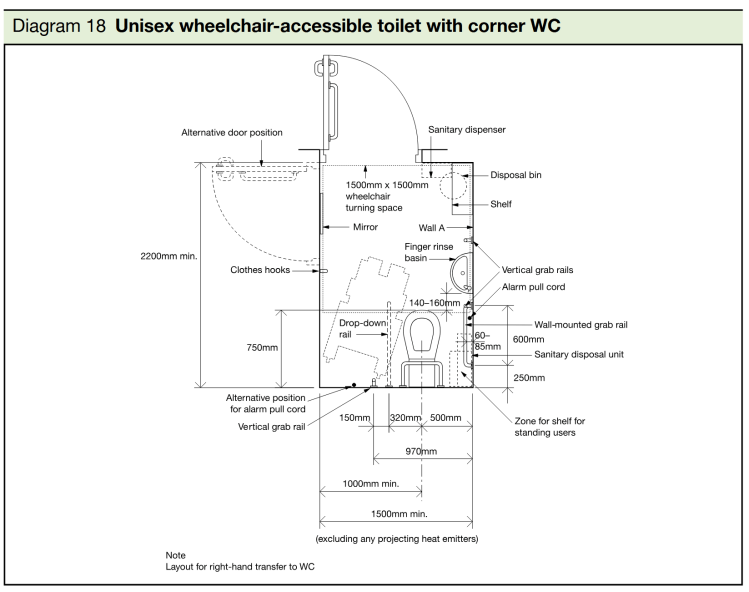
In the UK, everything is tightly choreographed. The basin sits within arm’s reach of the WC, perfectly placed for someone transferring or washing hands before repositioning their chair. Its a detail born of necessity, the space is small and every millimeter counts.
UK accessible bathroom
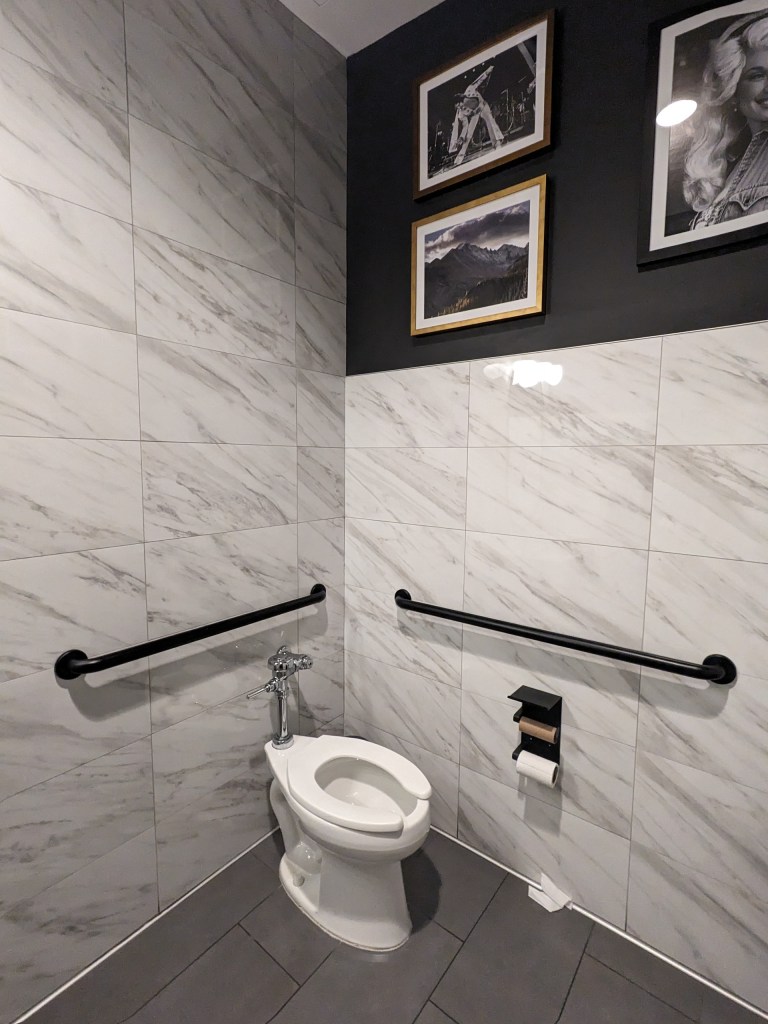
The drop down rail to the open side is another quiet triumph of practical design. It gives a user genuine independence and flexibility. I took it for granted until I began working in the US and realised that, under 521 CMR, it simply doesn’t exist. Instead, the grab bars are rigidly fixed: one to the side, one behind. I’ve yet to understand how the rear one truly helps anyone other than to bruise their knuckles!
US Accessible WC layout
Another key distinction is how the two systems define accessibility itself. In the UK, a building must provide a dedicated, self-contained accessible WC, a recognisable, stand-alone room with its own proportions and fittings. In the US, compliance can often be achieved within a main restroom if at least one stall meets the required dimensions and clearances. Both achieve accessibility, but in very different ways.
US Accessible stall layout
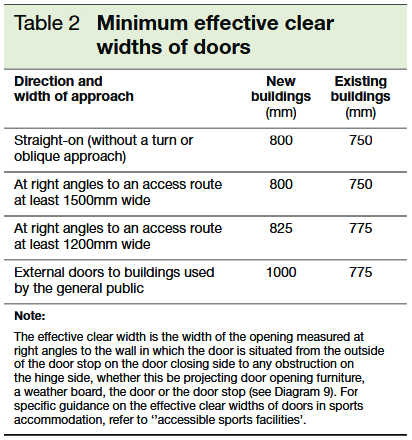
Door clearances tell another story. Both countries require almost the same. 800mm (31.5in) in the UK and 32in (813mm) in Massachusetts, yet the spatial choreography is entirely different. In the UK we only allow outward swinging doors to preserve manoeuvring space inside. In the US, may doors open inwards, prioritising the corridor over the room. It’s a subtle difference, but one that completely changes how a wheelchair user approaches the room.
Nothing captures the divide better than the electrics.
In the UK, a bathroom is practically sacred ground: sockets are banned except for shaver outlets, and even then only beyond Zone 2 per BS 7671:2018. These zones are measured distances from baths, basins, and showers, designed to keep electricity far from splashes.
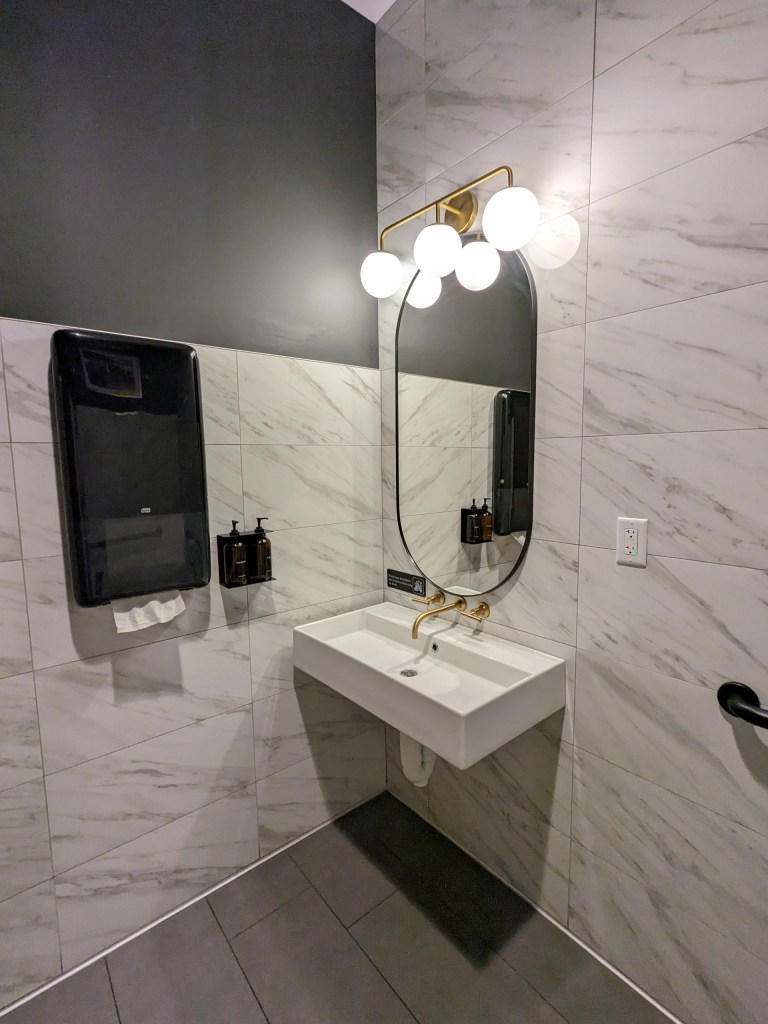
In the US, bathrooms are dotted with GFCI-protected outlets (see those reset buttons?). They’re near sinks, mirrors, and even beside toilets. It’s a fascinating contrast in risk philosophy: British caution versus American convenience.
Modern styled US ADA sink and mirrorModern styled US accessible WC with grab bars
Visual contrast is another area where British precision meets American looseness in my experience. In the UK, we follow Light Reflectance Value (LRV) guidance, ensuring atleast 30-point difference between grab rails and their backgrounds. Consider black being 0 LRV and pure white is 100 reflecting all light. It’s a subtle way of making fittings visible to people with low vision.
UK Accessible WC, note the grab bars!
In the US, contrast is often left to aesthetic preference. Accessibility is measured in inches and pounds, not colo(u)rs and tones. It’s an omission that says as much about regulatory culture as it does about design priorities.
Interesting the roles reverse when it comes to water efficiency. Massachusetts is impressively strict: WCs are limited to 1.28 gallons per flush (4.8L). The UK’s Part G takes a broader approach, suggesting limits but often leaving specifics to voluntary schemes.
So while the British bathroom is spatially efficient, the American one is environmentally so.
Another US bathroom, just look at the size and style!!
If I had to sum up the difference, I’d say the US bathroom is experience-driven; the UK bathroom is compliance-driven.
The American approach is about comfort and perception, generous space, abundant lighting and a sense of calm. The British approach is about precision, meeting the diagram, hitting the numbers and proving inclusivity through layout rather than luxury.
Neither is wrong. Both are responses to context, climate, and culture. Yet I can’t help feeling that the perfect accessible bathroom lies somewhere between them.
Article 1 : The Transatlantic Divide: Building Science Across the Pond
Building science, or building physics, has always fascinated me, the way buildings respond to their environments, the materials we use, and the decisions that shape how we live within them.
Over the years, my work as a practising architect in the UK and as a contractor in the New England states of the US has given me a unique vantage point. Moving between two building cultures, I’ve come to appreciate just how differently we think about constructing the same thing: simple, comfortable, and efficient buildings.
At a first glance, the principles seem universal, insulation, airtightness, ventilation, comfort. But the moment you look closer, the variations are striking. The regulations along, from the UK’s Building Regulations to Massachusetts’ State Building Code, reveal two distinct philosophies. What’s considered standard practice in one country can be a curiosity in the other. Even the most ordinary details, a bathroom layout or wall build-up, can expose decades of divergent climate responses, construction traditions, and cultural expectations.
In the UK, we tend to build with masonry and layers of insulation, prioritising compactness and energy efficiency. Across the Atlantic, timber framing dominates, and comfort often means more space and more mechanical control. Neither is inherently ‘better’, they simply tell different stories about how we’ve adapted to our environments and economies.
This series is my attempt to explore those stories. It’s not a textbook or code manual, but a place to share observations, research, and reflections on how we design, build, and occupy our spaces. Some articles will be technical; others more anecdotal. The aim is to bridge the gap between theory and practice, and between the two construction cultures that have more in common than they realise.
Whether you’re an architect, a student, or someone simply curious about why buildings are the way they are, I hope these notes offer both insight and inspiration. I’ll touch on everything from thermal performance to material choices, from the quirks of US bathroom sizing to the science of airtightness (if I can unravel that!) and perhaps along the way, we can start to see how the two worlds might learn from each other.
As we close out another year and welcome in a new one, I wanted to take a moment to reflect on the past and look ahead to the future. It has been an interesting and challenging year, and I am grateful for the opportunity to continue learning and growing as an architect.
As I look ahead to the new year, I am filled with excitement and anticipation for what is to come. I don’t know exactly where my path will take me, but I am ready to embrace new opportunities and challenges as they arise. With new project, continuing studies, and working on personal projects, I am eager to see where my passions and interests will lead me.
I want to thank all of my readers for following along on my journey. Your support and encouragement have meant a lot to me, and I am grateful to have such a wonderful community to share my experiences with.
Here’s to a new year full of possibilities and growth. I am looking forward to seeing where things go, and I hope you are too.
I am thrilled to announce that I have successfully completed my dissertation, encompassing the role of the digital world within architecture. It has been a long and challenging journey, but I am so proud of the results and grateful for the support of my tutors, colleagues, friends and family.
Through my research and writing, I explored the increasingly important role of digital technology in the field of architecture. From design and visualization tools to construction and project management, the digital world has transformed the way we approach and create buildings and spaces.
As I look back on the past year, I am grateful for the opportunity to study and learn about the fascinating world of architecture. It has been a privilege to delve into the history, theory, and practice of this field, and I am excited to continue exploring and growing as an architect in the future.
As the holiday season approaches, I want to take a moment to wish all of my fellow students, colleagues, and readers a very merry Christmas. I hope that you are able to spend time with loved ones, relax, and recharge during this special time of year.
Thank you for following along on my journey as a student architect. I am excited to see what the future holds and look forward to sharing more updates with you in the new year.
I am excited to announce that I have submitted my dissertation in architecture. This has been a long and challenging journey, and I am grateful to have reached this milestone. I want to take a moment to thank my tutors, professors, and peers for their support and guidance throughout this process. I could not have done it without them.
As I await feedback from my course, I am looking forward to seeing what they have to say about my work. I have put a lot of time, effort, and thought into this project, and I am eager to see how it is received. Whether the feedback is positive or constructive, I know it will help me to grow and improve as an architect.
In the meantime, I am progressing with other course submissions. Thank you for following my journey and I am excited to see what the future holds and look forward to sharing more updates soon.
This week I’ve been busy working on my design project. I’m looking at the brief of the main building; what are the spacial requirements and how this relates to the context.
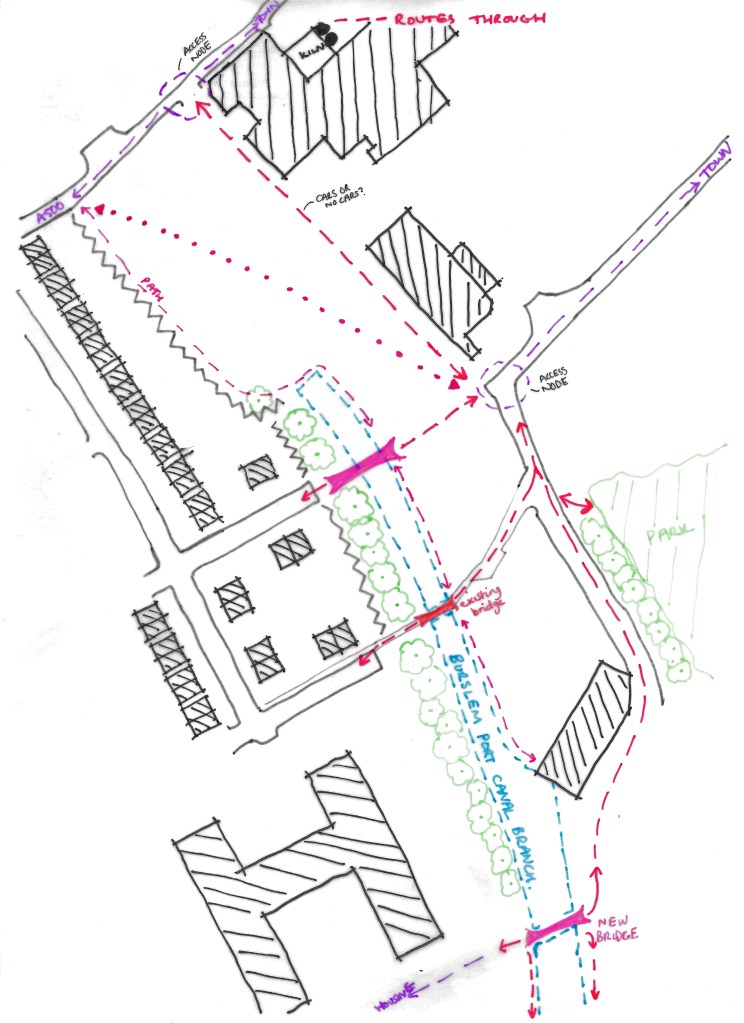
Looking at the wider masterplan of the site I’m exploring access to and through the site, exploring the history of the site and how this may inform the proposals.
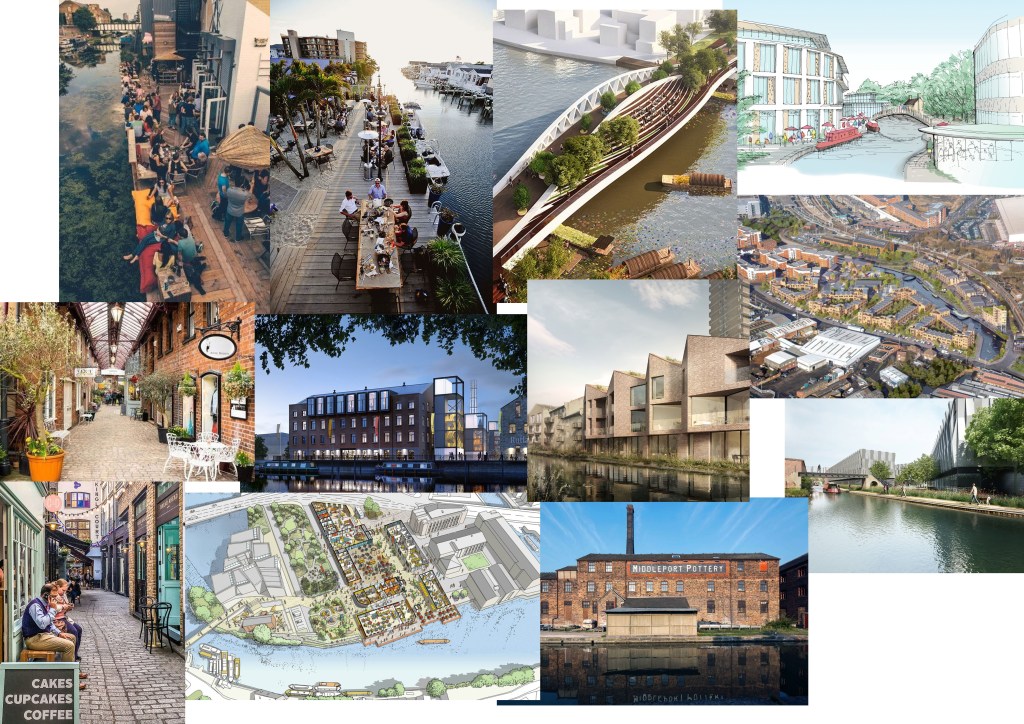
Next looking into precedent to guide the design I’ve found some interesting projects including; Hawkins/Brown Wakefield project next to the Hepworth to develop a 20yr disused mill on the canal front and a Chapman Taylor project in Wolverhampton.